
attraction · Cádiz
Castillo de Zahara de la Sierra
Andalucía 365 · Updated 18 July 2026
Our Verdict
“A steep but rewarding climb to a Nasrid keep offering unparalleled views over the Zahara-El Gastor reservoir.”
Last verified: July 2026
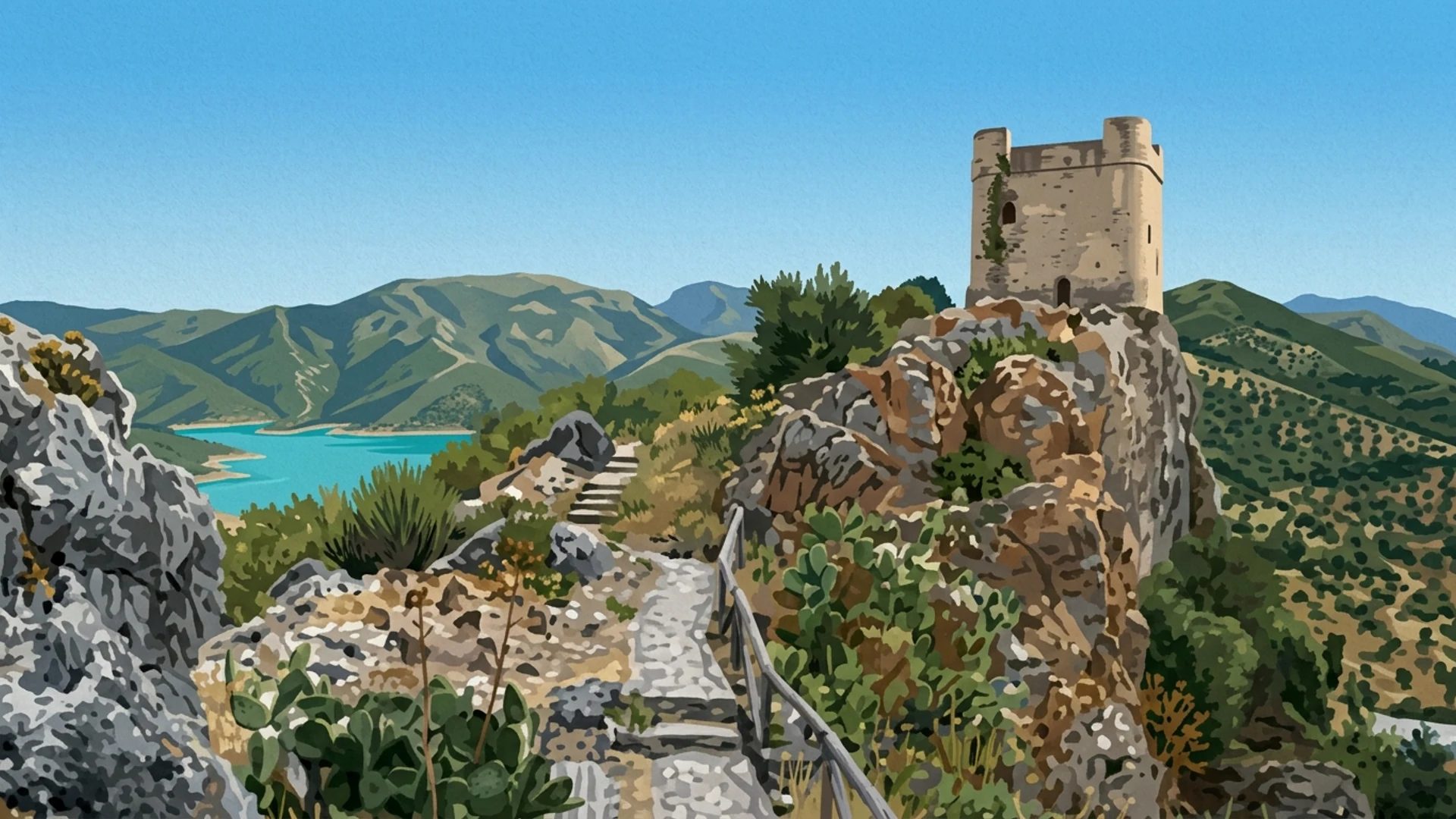
Perched on a craggy limestone outcrop above a turquoise reservoir, the Castillo de Zahara de la Sierra is a stark reminder of Andalucía’s volatile frontier history. Originally established by the Nasrid dynasty in the thirteenth century, this hilltop fortress once guarded the western approaches to the Kingdom of Granada. Today, its surviving Torre del Homenaje (keep) and fragmented defensive walls offer one of the most commanding panoramas in the White Villages of Cádiz. The site appeals to history enthusiasts, photographers, and active travellers willing to tackle the steep, exposed ascent from the village below. While the architectural remains are relatively sparse, the sheer dramatic scale of the landscape makes the climb a highly rewarding focal point for any journey through the region.
A Frontier Stronghold
The origins of the Castillo de Zahara de la Sierra lie in the thirteenth century, when the Nasrid rulers of Granada fortified this natural vantage point to defend their territory against the advancing Christian kingdoms. The fortress was designed to be virtually impregnable, exploiting the sheer drops of the rocky promontory to minimise the need for extensive artificial fortifications. For over two centuries, it served as a critical military outpost, controlling the vital mountain passes between Ronda and the Guadalquivir valley and protecting the agricultural lands below.
The castle's strategic value made it a frequent target during the Reconquista. It changed hands multiple times, most notably when it was captured by Christian forces in 1407, only to be retaken by the Nasrids in 1481. This bold recapture by the Emirate of Granada provided the Catholic Monarchs with the pretext they needed to launch the final, decisive war against the Nasrid kingdom. The fortress finally fell to Rodrigo Ponce de León in 1483, marking the end of its role as a Muslim stronghold and the beginning of its Christian adaptation. The village that once clustered tightly within the lower walls gradually expanded down the hillside in the centuries that followed, leaving the upper reaches to the military garrison.
The Torre del Homenaje
The most substantial surviving element of the medieval complex is the Torre del Homenaje, or keep, which stands at the highest point of the crag, 605 metres above sea level. This imposing structure is a prime example of transitional military architecture, blending original Nasrid foundations with extensive fifteenth-century Christian modifications, much like the nearby fortress in Olvera.
The tower features a square floor plan measuring roughly twelve metres on each side, with distinctively rounded corners, a design choice intended to deflect artillery fire and resist siege engines. The exterior walls are constructed from irregular masonry interspersed with brick courses, reflecting the pragmatic building techniques of the era. Inside, the structure is divided into two main levels, each containing four chambers separated by lowered arches and covered by vaulted brick ceilings. The lower chamber, which now serves as the primary entrance, features a large, enigmatic stone block of unknown function. The upper floor retains a Christian-era fireplace and two large windows that once provided crucial sightlines for the garrison to monitor troop movements across the valley. The flat roof, accessed via internal vaulted staircases, is crowned with four large corner merlons, offering an unobstructed 360-degree view of the surrounding landscape.
The Climb and the Panorama
Reaching the castle requires a physical commitment. The ascent begins from the village's upper streets, following a steep, winding path that cuts through the rocky terrain. The trail is lined with prickly pears, agave, and almond trees, passing the scattered foundations of the old medieval town and the remains of the original defensive walls. Recent archaeological work has also highlighted the presence of a Nasrid-era cistern (aljibe) beneath the keep, which once ensured the garrison had a reliable water supply during prolonged sieges, a crucial feature for any hilltop fortification.
The effort of the climb is entirely justified by the panorama from the summit. To the north, the vivid blue waters of the Zahara-El Gastor reservoir create a striking contrast against the arid limestone landscape, a modern addition that has fundamentally altered the visual character of the valley. To the south and east, the rugged peaks of the Sierra de Grazalema dominate the horizon, their slopes blanketed in dense Mediterranean scrub and Spanish firs. On clear days, the line of sight extends across the province, illustrating exactly why this specific crag was chosen as a military lookout centuries ago.
Our verdict
The Castillo de Zahara de la Sierra is not a polished, fully restored palace; it is a raw, weathered ruin that demands a degree of exertion to appreciate. Visitors expecting extensive museum exhibits, intact courtyards, or comprehensive interpretive panels will be disappointed, as the site consists primarily of the keep and fragmented walls. Furthermore, access to the interior of the Torre del Homenaje can be inconsistent, depending on ongoing municipal restoration work and staffing.
However, as a historical vantage point, it is exceptional. The fortress provides a tangible sense of the region's frontier past, and the views over the reservoir and the surrounding mountains are among the finest in the province. For those exploring the area, the climb is a highly recommended physical and visual experience that grounds the history of the Reconquista in its dramatic geographical context.
Practicalities
The path to the castle is steep, uneven, and entirely exposed to the elements. It is not suitable for wheelchair users, pushchairs, or those with significant mobility impairments. Sturdy footwear is essential, as the loose gravel and worn stone steps can be slippery, particularly on the descent.
When planning your ascent, keep the following seasonal factors in mind:
- Summer: The heat on the exposed rock face can be intense. It is strongly advisable to attempt the climb early in the morning or late in the afternoon to avoid the peak sun. Carrying water is a necessity as there are no facilities on the hillside.
- Winter: The summit can be subjected to strong, biting winds sweeping across the reservoir, so layered clothing is highly recommended.
- Spring and Autumn: These seasons offer the most comfortable climbing conditions and the clearest visibility for photography.
Entry to the castle grounds is generally free and open, allowing visitors to explore the exterior ruins at their own pace. However, the interior of the keep may have specific opening hours or require a guided tour arranged through the local tourist office. Visitors should consult the official cultural agenda for the most current access arrangements before planning their ascent.
Nearby worth your time
A few well-placed stops for extending the day without turning it into a checklist.
Continue through Pueblos Blancos
Step back into the wider landscape with local guides, nearby places and the province overview.
Place guide · 7 min
Playa de La Caleta: A Guide to the Historic Heart of Cádiz
Playa de La Caleta is a historic urban bay in Cádiz, famous for its calm waters, ancient fortresses, and the stunning white Balneario spa building.
Place guide · 7 min
Playa de los Caños de Meca: A Guide to the Cádiz Coastline
Discover the wild Atlantic beauty of Playa de los Caños de Meca, from its freshwater springs to the historic Cape Trafalgar lighthouse.
Itinerary · 7 min
Three Days in Cadiz: The Ultimate Itinerary for Independent Travellers
Three days allows you to completely sink into the maritime rhythm of Europe's oldest city. You can cover the historic centre, explore the twin seaside fortresses, and still have time for a sherry tasting afternoon across the bay.