
Feature · Sevilla
Itálica and the Emperor-Makers
Founded for wounded soldiers after a crushing military victory, Itálica rose from a provincial outpost to become a political powerhouse. By the second century AD, this settlement in southern Spain was reshaping the Roman world, producing two of its most formidable emperors.
By Dan · Updated 21 June 2026 · 9 min read
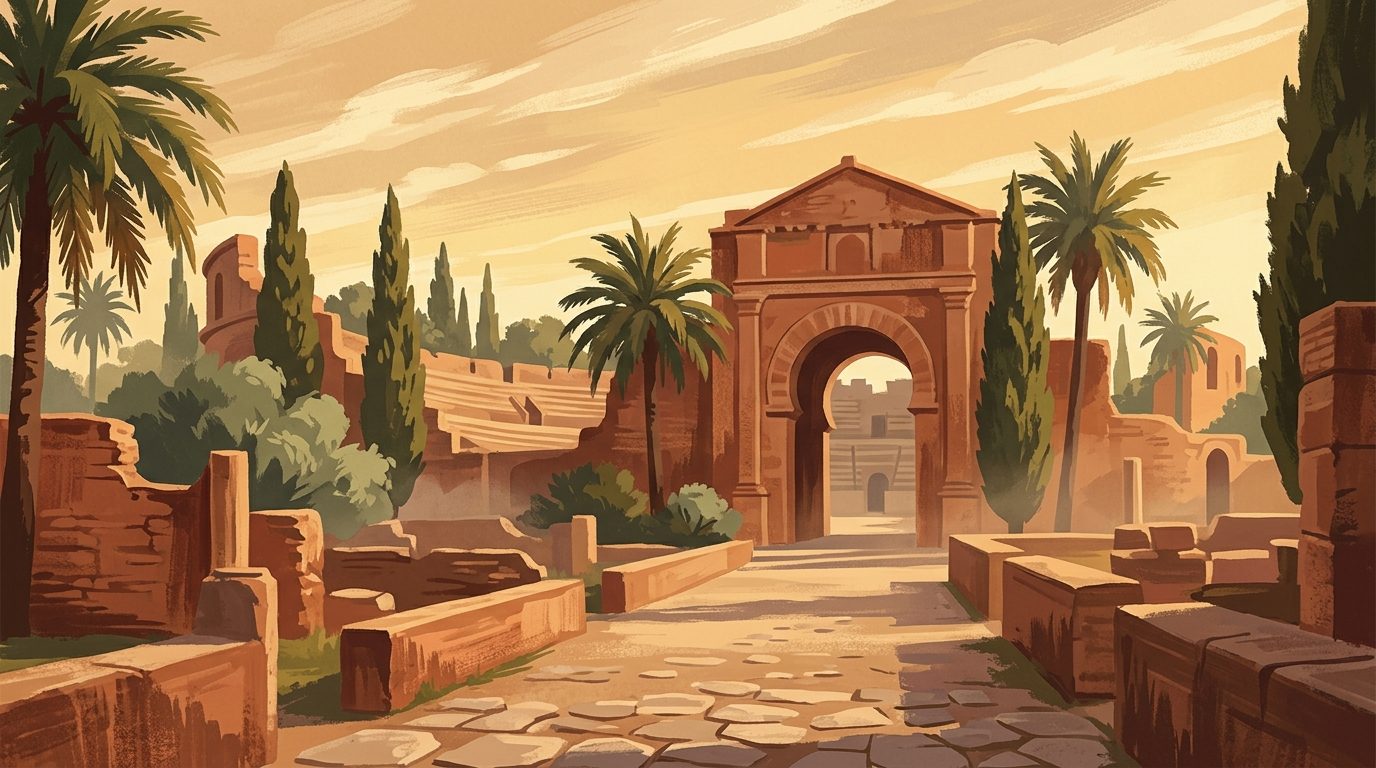
Founded for wounded soldiers after a crushing military victory, Itálica rose from a provincial outpost to become a political powerhouse. By the second century AD, this settlement in southern Spain was reshaping the Roman world, producing two of its most formidable emperors.
In 206 BC, the Roman general Publius Cornelius Scipio secured a decisive victory against Carthaginian forces at the Battle of Ilipa. The battle left him with a vast number of wounded veteran soldiers who could not make the arduous journey back to Italy. Scipio identified a gentle hill rising above the west bank of the Baetis river (the modern Guadalquivir) and established a settlement for them. He named it Itálica. This foundation occurred early in the era of Roman Hispania Baetica (218 BC to AD 409), setting a precedent that would alter the course of European politics.
Itálica was the first Roman city established entirely outside the Italian peninsula. Initially a humble garrison town designed to secure newly conquered territory, it evolved over the next three centuries into an astonishingly wealthy civic centre. The descendants of Scipio's soldiers capitalised on the fertile land of the Guadalquivir valley. They exported vast quantities of olive oil, grain and metallic ores back to the imperial capital.
As their wealth grew, so did their political ambition. These provincial elites married into prominent local Turdetanian families, bought up immense estates, funded grand public works, and eventually sent their sons to Rome to enter the Senate. Their ascent was so successful that they achieved the ultimate prize. The provincial upstarts of Itálica seized the imperial throne itself.
The Rise of the Provincial Elite
The transformation of Itálica from a military hospital camp into an incubator for emperors did not happen overnight. It was the result of generations of strategic marriages and calculated financial investments. By the first century AD, the province of Baetica was the primary supplier of olive oil to Rome. The families who controlled this trade accrued fortunes that rivalled those of the oldest patrician bloodlines in the capital.
Two families from Itálica became particularly prominent in Rome: the gens Ulpia and the gens Aelia. Despite their enormous wealth, Roman traditionalists initially viewed these provincial senators with deep suspicion. They were mocked for their provincial accents and their lack of ancestral pedigree. However, the civil wars and political purges of the first century AD severely depleted the traditional Roman aristocracy. Emperors like Vespasian began promoting wealthy, loyal provincials into the patrician class to fill the ranks of the Senate and the military command.
The men of Itálica were perfectly positioned to take advantage of this shift. They were fiercely loyal to the state, highly educated, and possessed the financial means to sponsor games, construct public buildings, and maintain large networks of clients.
Trajan: The First Provincial Emperor
The ultimate breakthrough came with Marcus Ulpius Traianus, known to history as Trajan. Born in Itálica in AD 53, Trajan followed his father into the imperial administration, building a formidable reputation as a military commander along the perilous Rhine and Danube frontiers. In AD 97, the elderly and politically weak Emperor Nerva faced a mutiny from the Praetorian Guard. Desperate for legitimacy and military backing, Nerva adopted the highly respected Trajan as his son and heir.
When Nerva died the following year, Trajan ascended to the throne. He was the first Roman emperor born outside Italy. His reign (AD 98 to 117) is remembered as an era of unprecedented military success and internal stability. Trajan expanded the empire to its greatest historical extent, conquering Dacia (modern Romania) and pushing the eastern borders deep into Parthian territory. He used the spoils of these wars to fund massive public building programmes in Rome, including Trajan's Forum and his famous commemorative column.
Interestingly, despite his affection for his birthplace, Trajan spent very little time in Itálica after his youth. He was a soldier at heart, and his focus remained fixed on the frontiers and the capital. Yet, the mere fact of his ascension brought immense prestige to the city in Andalucía. Itálica was no longer just a wealthy provincial town. It was the cradle of the emperor.
Hadrian and the Nova Urbs
Trajan was succeeded by his ward and fellow family member, Publius Aelius Hadrianus. Whether Hadrian was physically born in Rome or Itálica remains a subject of debate among historians, but his family roots were firmly planted in the Andalucían city. Hadrian's reign (AD 117 to 138) marked a distinct shift from Trajan's aggressive expansionism. Hadrian focused on consolidating the empire, securing its borders, and unifying its diverse cultures through a massive programme of civic patronage.
Nowhere was this patronage more spectacularly displayed than in Itálica. Hadrian elevated his ancestral home to the status of a colonia, granting its citizens full Roman rights. More significantly, he initiated a monumental expansion of the settlement. He ordered the construction of a sprawling new district known as the Nova Urbs (New City), built on the higher ground adjacent to the original republican settlement, the Vetus Urbs.
The Nova Urbs was not built out of necessity. The original city was perfectly adequate for the existing population. Instead, this new district was a deliberate political statement, a showpiece designed to project imperial power and honour the dynasty's origins. It was laid out on a rigid, orthogonal grid, featuring streets up to fifteen metres wide, complete with colonnaded pavements and a sophisticated subterranean drainage system.
The Amphitheatre and the Traianeum
The sheer scale of Hadrian's vision is best understood through the public monuments he commissioned. The most striking addition to the city was the amphitheatre. Built to accommodate an astonishing 25,000 spectators, it was one of the largest in the entire Roman Empire. This capacity far exceeded the actual population of Itálica, which historians estimate at roughly 8,000 residents. The amphitheatre was clearly designed as a regional destination, a place where people from across Baetica would gather to witness gladiatorial combat and wild beast hunts.
The arena featured a massive fossa bestiaria, a deep central trench that housed the cages and lifting mechanisms for the animals. Spectators would watch in awe as lions, bears and leopards seemingly appeared out of nowhere to face the gladiators.
Equally impressive, though less intact today, was the Traianeum. This immense temple complex was dedicated to the deified Emperor Trajan. It sat on a highly elevated podium, surrounded by an extensive colonnaded courtyard. The temple served as the religious and ideological heart of the Nova Urbs, reinforcing the divine status of the local boy who had conquered the world.
A City of Mansions and Mosaics
The residential areas of the Nova Urbs were just as ambitious as its public buildings. The city was populated by sprawling, luxurious patrician houses known as domus. Some of these mansions covered over 1,700 square metres, taking up entire city blocks. They were designed for aristocratic families who wanted to emulate the opulent lifestyles of the capital.
These homes featured private thermal baths, central courtyards adorned with imported marble columns, and intricate water features. However, their defining characteristic was the quality of their floor mosaics. Roman artisans laid down millions of tiny stone tesserae to create vivid mythological scenes and geometric patterns. In the House of the Planetarium, the floors depicted the deities associated with the days of the week. In the House of the Birds, artists rendered dozens of different avian species in painstaking detail.
The Slow Retreat
Despite the immense resources poured into the Nova Urbs, Hadrian's grand project was ultimately doomed by geography and economics. The expansion was built on high ground, which required a complex and expensive aqueduct system to maintain a water supply from springs nearly forty kilometres away. Furthermore, the Guadalquivir river, the economic lifeline of the region, began to shift its course and silt up, making the inland port increasingly difficult to navigate.
By the third century AD, the Roman Empire was engulfed in a severe economic and military crisis. The funds required to maintain the monumental infrastructure of the new city simply dried up. Gradually, the residents abandoned the grand mansions on the hill and retreated down to the more manageable Vetus Urbs by the riverbanks. The grandiose Nova Urbs was left to the elements. Over the centuries, its temples were dismantled, its marbles burned for lime, and its walls used as a quarry by later generations building nearby Sevilla.
Where to see it today
The remains of Hadrian's great expansion can be explored at the Conjunto Arqueológico de Itálica, located in the modern town of Santiponce. Because the Nova Urbs was abandoned rather than built over, it offers a rare, unobstructed layout of an elite Roman street grid. The Vetus Urbs, by contrast, lies buried and largely unexcavated beneath the streets and houses of Santiponce itself.
At the archaeological site, the undeniable highlight is the amphitheatre. You can walk through the vaulted concrete galleries, stand on the terraces where 25,000 spectators once cheered, and look down into the exposed brickwork of the animal pits in the centre of the arena. The scale of the structure provides an immediate physical understanding of the region's historical wealth.
Further up the hill, the site preserves the foundations of the immense mansions. The House of the Birds, the House of the Planetarium, and the House of the Exedra still display many of their original floor mosaics in situ, protected by low roofs. You can trace the wide, paved avenues that once connected these homes to the public baths and the temple complex.
To see the finest portable artefacts from Itálica, you must look beyond the ruins. The monumental imperial statues excavated here, including heroic depictions of Trajan and Hadrian, belong to the collections of the Museo Arqueológico de Sevilla (Note: The Museo Arqueológico de Sevilla is currently undergoing major renovation. Please check the official website for the current location of the 'Itálica' collection, typically housed in a temporary exhibition at the Convento de Santa Inés.). Additionally, in the early twentieth century, the Countess of Lebrija purchased several complete mosaic floors from Itálica and used them to pave the courtyards of the Palacio de la Condesa de Lebrija in central Sevilla. The magnificent central mosaic depicting the god Pan remains one of the best-preserved examples of Itálica's domestic art, now housed within a Renaissance palace.
If you visit
The ruins of Itálica are remarkably accessible, situated just nine kilometres northwest of Sevilla. The site is easily reached by taking the M-170 bus from the Plaza de Armas bus station (check the timetable on the official Consorcio de Transporte Metropolitano website before travelling), which drops you directly outside the entrance in Santiponce. The archaeological park is vast and offers very little natural shade. Consequently, the high summer temperatures in Andalucía make midday visits uncomfortable and potentially dangerous. The best times to explore the ruins are during the spring or autumn, or as soon as the gates open in the morning. Wear comfortable walking shoes to navigate the uneven Roman paving stones and dirt paths. The site is closed on Mondays (except some public holidays), so plan your itinerary accordingly (check on the operator's website before travelling).
Last reviewed: 21 June 2026 · Editorial policy
Related guides
Exploring Sevilla Cathedral and the Giralda Tower
Sevilla Cathedral is the largest Gothic church in the world, home to the Giralda tower and the tomb of Christopher Columbus.
5 min read
Discovering Triana: The Soul of Sevilla Beyond the River
Connected to the main city by the iconic Puente de Isabel II, Triana is a district with its own distinct seafaring and artisanal identity. From legendary ceramics workshops to the birthplace of flamenco, this neighbourhood offers an authentic side of Sevilla.
6 min read
A Guide to Utrera: The Cradle of Soleá and Sevilla’s Countryside Heartland
Utrera serves as a pillar of Andalucían culture, renowned for its deep flamenco roots and the striking architecture of its historic churches.
6 min read
The Granite and the Geranium: The Fragile Geometry of Córdoba’s May
For two weeks in May, Córdoba’s residents throw open the doors of their private courtyards, turning a city of stone into a living, breathing laboratory of botanical obsession.
6 min read
The Ghost in the Garden: Searching for the Al-Andalus Within
Eight centuries of Al-Andalus did not vanish in 1492; they simply moved indoors, into the kitchens, and onto the tip of the tongue.
7 min read
The Morisco Revolt of the Alpujarras
The Morisco Revolt of 1568 transformed the mountainous terrain of the Alpujarras into the theatre of a brutal war. Driven to rebellion by laws erasing their culture, the descendants of Granada's Muslim population fought a desperate campaign against the Spanish Crown.
8 min read
More from Sevilla
Roman Hispania Baetica: Itálica, Baelo Claudia and the Olive Economy
How did a distant southern province become the economic engine of the Roman Empire and the birthplace of emperors? The answer lies in the fertile soils and sheltered harbours of Hispania Baetica.
7 min read
Semana Santa in Sevilla: A First-Timer's Guide
Semana Santa in Sevilla is an intense expression of faith, art and civic identity. Unlike other cities, the spectacular wooden floats are carried from below by hidden costaleros, moving to the slow beat of mourning marches or absolute silence.
8 min read
The Siege of the Real: Inside Sevilla’s Private Universe
Beyond the yellow dust of the Real, Sevilla’s great fair is a labyrinth of closed doors where the city’s true social hierarchy is revealed in the clinking of glasses.
8 min read
Newsletter
More stories from Andalucía
Weekly notes, seasonal picks, and the next guides worth bookmarking.