
Feature
Roman Villas and Mosaics: Life on the Country Estates of Baetica
Far from the noise of the forum, the rural estates of southern Spain became centres of immense wealth and artistic patronage. Here, Roman elites built palatial homes surrounded by the olive groves and wheat fields that fed the empire.
By Dan · Updated 21 June 2026 · 7 min read
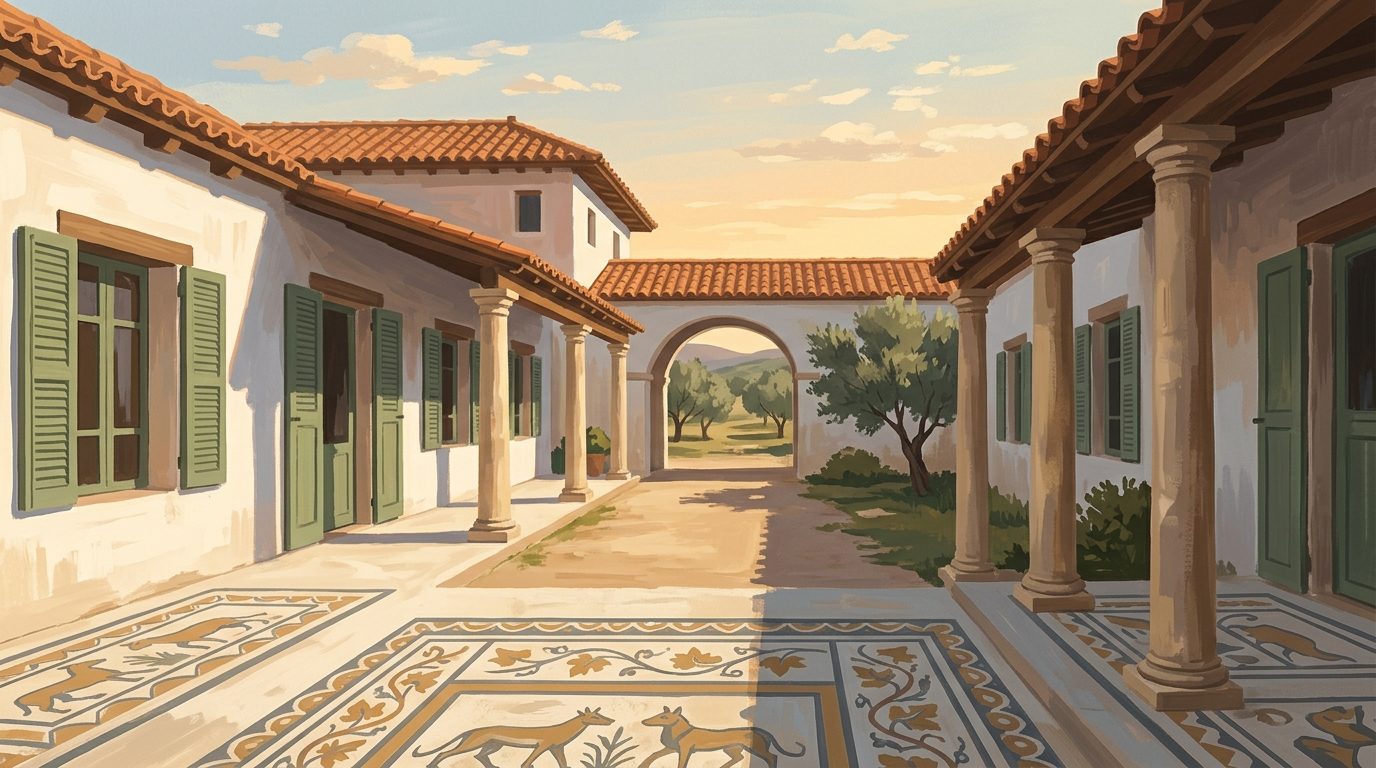
Far from the noise of the forum, the rural estates of southern Spain became centres of immense wealth and artistic patronage. Here, Roman elites built palatial homes surrounded by the olive groves and wheat fields that fed the empire.
In 1988, workers clearing ground for a new road near the village of Almedinilla uncovered the delicate bronze face of a sleeping youth. It was Hypnos, the Greek god of sleep, cast with closed eyes and small wings sprouting from his temples. This extraordinary sculpture did not belong to a civic temple or a public square. It was the private property of a rural landowner, a focal point in the reception rooms of a sprawling country estate. Set within the broader era of Roman Hispania Baetica from 218 BC to AD 409, the agricultural heartlands of southern Spain were far more than simple farming districts. They were landscapes dominated by immense private wealth.
The provincial elite constructed magnificent residences across the countryside, creating highly cultivated retreats that merged heavy industry with high art. The discovery of the Almedinilla bronze proved that the highest levels of Roman art were not confined to the provincial capitals. They were deeply embedded in the countryside. For the Roman aristocrat, the rural villa was a place of otium, a concept of active leisure devoted to study, dining, and refined living, set in deliberate contrast to the negotium of urban politics and business. Today, the excavated remains of these rural villas reveal exactly how the wealthiest citizens of the empire lived, commanded their estates, and displayed their power.
The Rural Engine of the Empire
The economy of Roman Andalucía relied on the fertile plains of the Guadalquivir valley. The region produced staggering quantities of grain, wine, and above all, olive oil. The amphorae that carried Baetican oil to Rome still form the bulk of Monte Testaccio, an artificial hill in the Italian capital made entirely of broken pottery. The engine behind this phenomenal output was the latifundium, a vast agricultural estate owned by a senatorial or equestrian family.
At the centre of the latifundium stood the villa complex. Roman agronomists divided these settlements into two distinct halves. The pars rustica contained the working farm, including olive presses, grain stores, slave quarters, and stables. The heavy clay soils along the Guadalquivir river were perfectly suited to olive cultivation, and to facilitate export, many rural estates built their own kilns to manufacture the large clay amphorae needed for shipping. The estates were worked by a massive labour force. During the early empire, this consisted largely of enslaved people. In later centuries, the system transitioned towards the use of coloni, tenant farmers who were bound to the land, laying the earliest foundations for the rural systems of the medieval period.
The pars urbana served as the residential wing for the owner and their family. While the owner might spend much of the year participating in civic life in a city like Corduba or Hispalis, the rural estate remained their primary source of income and a crucial venue for entertaining peers.
Art and Architecture of the Country Estate
During the late republic and early empire, these rural homes were comfortable but relatively modest. However, as the empire progressed, the nature of rural life shifted dramatically. By the late third and fourth centuries AD, the economic focus of the empire began to move away from the cities. As the financial burden of holding civic office grew heavier, local magistrates became reluctant to fund public buildings in urban centres. Instead, they directed their vast fortunes entirely into their private rural homes. Landowners withdrew to their estates, expanding their pars urbana into palatial compounds designed to impress guests and assert their enduring social dominance.
The heart of the late Roman villa was the peristyle, an open courtyard surrounded by a colonnaded walkway. This space provided light, air, and a private garden where the family could walk in the shade. Water played a central role in the architecture. High-status homes featured ornamental pools, fountains, and nymphaea (monumental water shrines) that cooled the dry summer air and demonstrated the owner had the engineering capability to command a private water supply. Walls were brightly painted with frescoes imitating expensive marble veneers or depicting lush garden scenes.
The most important room in the house was the triclinium, or formal dining room. Roman social life revolved around the convivium, a highly structured dinner party where hosts reinforced political alliances and displayed their culture. Dining rooms were deliberately designed with wide entryways so that guests approaching from the peristyle could immediately see the elaborate floors and painted walls. Many villas also included private bathhouses equipped with underfloor heating, hot and cold pools, and vaulted ceilings.
Floors of Stone and Glass
The defining artistic feature of the Baetican country estate was the mosaic floor. Using the technique known as opus tessellatum, craftsmen arranged thousands of tiny cut stones, glass fragments, and terracotta pieces into complex geometric patterns and figurative scenes. Laying a mosaic was a highly specialised process. The floor required multiple layers of foundation: a base of large stones, a layer of crushed rubble and lime, and a fine mortar setting bed into which the tesserae were pressed before being grouted and polished.
Mosaic workshops operated across the region, developing distinct local styles. The surviving floors offer a direct window into the minds of the Roman elite. Mosaics were rarely chosen simply for their aesthetic value. They were carefully selected to project the owner's classical education and cultural refinement. The central figurative panels were often framed by intricate borders featuring guilloche, wave, or meander patterns. While the majority of the tesserae were cut from local limestone and marble to provide shades of white, black, red, and yellow, the craftsmen frequently imported expensive glass paste to achieve brilliant blues and greens for water scenes or foliage.
Mythological scenes were particularly popular. Depictions of Bacchus, the god of wine, signalled agricultural fertility and hospitality. Stories of Greek heroes like Achilles or Odysseus proved that the provincial landowner was deeply connected to the broader classical world. In other rooms, mosaics depicted hunting scenes or the changing of the seasons, celebrating the rural environment that generated the family's wealth.
Where to see it today
Villa romana de El Ruedo (Almedinilla)
This site in the province of Córdoba is one of the most complete rural villas in the region. The residential layout is exceptionally clear, built around a central courtyard. The main dining room retains its monumental nymphaeum, a curved water feature that would have formed a spectacular backdrop to elite dinner parties. The adjoining local museum houses the famous bronze statue of Hypnos alongside agricultural tools and domestic items recovered from the site.
Villa romana de Fuente Álamo (Puente Genil)
Located nearby, this site is famous for its extraordinary collection of mosaics. The floors date primarily to the fourth century AD, reflecting the late antique boom in rural wealth. Visitors can view a large mosaic depicting the Three Graces, as well as a fascinating Nilotic scene showing pygmies fighting crocodiles among lotus flowers. Such Egyptian motifs were highly fashionable and demonstrated the worldly tastes of the Baetican elite. The site is sheltered by a modern protective canopy, allowing visitors to view the mosaics in their original positions from elevated walkways.
Museo Histórico Municipal de Écija
The modern town of Écija sits on the site of ancient Astigi, a major Roman administrative centre surrounded by highly productive agricultural estates. The town museum houses an astonishing array of mosaics recovered from the area, including the famous Bacchic Triumph mosaic and the spectacular Double Abduction mosaic. The sheer concentration of high-quality floors found in and around Écija indicates that a highly skilled, permanently established mosaic workshop operated in the area for generations.
Museo Arqueológico de Sevilla
The provincial archaeological museum holds an outstanding collection of Roman mosaics rescued from rural estates and urban centres across the region. Among the most famous is the Judgment of Paris mosaic, which showcases the incredible technical skill of local workshops in rendering human figures and complex narratives. Please note: as of May 2026, the main building remains closed for major restoration (expected to continue throughout 2026). Visitors should check the official Junta de Andalucía website for access to temporary exhibitions of the Roman collection elsewhere in the city.
If you visit
The rural villas of the interior are best explored by renting a car. A logical itinerary involves driving through the olive-growing regions of Córdoba to visit the archaeological sites of Almedinilla and Puente Genil in a single day. Spring and autumn are the ideal times to explore these outdoor sites, as the summer temperatures in the Guadalquivir valley frequently exceed forty degrees Celsius.
Practical Information
Opening hours for rural archaeological sites can vary significantly by season and day of the week, so always confirm times locally before setting out. For official ticketing and up-to-date visiting hours, check the official sites for Villa romana de El Ruedo and Fuente Álamo.
Last reviewed: 21 June 2026 · Editorial policy
Related guides
The Ghost in the Garden: Searching for the Al-Andalus Within
Eight centuries of Al-Andalus did not vanish in 1492; they simply moved indoors, into the kitchens, and onto the tip of the tongue.
7 min read
The Reconquista in Andalucía
The centuries-long Christian conquest of southern Iberia redefined the physical and cultural landscape of the peninsula. How did the military campaigns of the northern kingdoms dismantle the Islamic territories of Al-Andalus and forge the modern region of Andalucía?
7 min read
Corduba and Roman Baetica
Discover the political and intellectual might of Corduba, the wealthy administrative capital of Roman Baetica and the birthplace of the philosopher Seneca.
7 min read
Al-Andalus: Eight Centuries of Moorish Rule in Andalucía
For nearly eight hundred years, Islamic civilisation flourished on the Iberian Peninsula. How did a distant province of the Umayyad empire become a beacon of science, art, and poetry in medieval Europe?
8 min read
Cathedrals and Great Churches of Andalucía
A guide to the monumental religious architecture of Southern Spain, from the vast Gothic nave of Sevilla to the Renaissance masterworks of Jaén and Granada.
6 min read
Phoenicians and Tartessians in Andalucía
Around three thousand years ago, eastern Mediterranean merchants arrived on the Iberian coast seeking silver and copper. Their arrival sparked a cultural collision that transformed local chiefdoms into the legendary civilisation of Tartessos.
6 min read
More guides
UNESCO World Heritage Sites in Andalucía
A curated guide to the cultural and natural sites in Andalucía recognised by UNESCO for their universal value. These landmarks offer a profound insight into the diverse civilisations of the region.
6 min read
The Best Beaches in Andalucía
From the Atlantic dunes of Huelva to the volcanic coves of Almería, the coastline of southern Spain offers an unparalleled variety of maritime landscapes.
6 min read
Roman Andalucía: Ruins and Archaeological Sites
Discover the monumental legacy of the Roman province of Baetica, from grand amphitheatres in the Guadalquivir valley to maritime cities on the Atlantic coast.
7 min read
Geological Wonders: Caves and Karst Landscapes of Andalucía
Discover the subterranean wonders and prehistoric secrets preserved within the limestone massifs and gypsum deposits of southern Spain.
6 min read
Castles and Fortresses of Andalucía
The fortresses of Andalucía are the stone guardians of a complex past, marking the ancient frontiers between empires and offering some of the most spectacular views in the southern peninsula.
6 min read
The Iberians in Andalucía: Warlords, Sculptors and the Dawn of Iron
Who were the sophisticated, iron-working peoples who controlled southern Spain before the Roman conquest? Their fortified hill towns and striking stone sculptures reveal a formidable culture caught between ancient local traditions and Mediterranean ambition.
6 min read
UNESCO Geoparks and Natural Wonders of Andalucía
Discover the geological heritage of Southern Spain through its UNESCO-designated geoparks and natural wonders. Explore the tectonic history and diverse ecosystems of Almería, Granada, and Cádiz.
6 min read
The White Villages of Andalucía: A Guide to the Pueblos Blancos
Discover the iconic white villages of Cádiz and Málaga, where lime-washed houses and narrow Moorish streets define the rugged mountain landscape of Andalucía.
6 min read
Hot Springs of Andalucía
Discover the ancient thermal traditions of Andalucía, where mineral-rich waters from the Sierra Nevada and beyond offer a timeless connection to the region's Roman and Moorish past.
6 min read
Newsletter
More stories from Andalucía
Weekly notes, seasonal picks, and the next guides worth bookmarking.