
Feature
The Berber Empires: Almoravids, Almohads and the Rebuilding of Sevilla
The arrival of the North African Almoravid and Almohad dynasties shifted the centre of Islamic power in the Iberian Peninsula. They brought austere religious reform, immense military strength, and a monumental architectural vision that permanently reshaped Sevilla.
By Dan · Updated 24 June 2026 · 7 min read
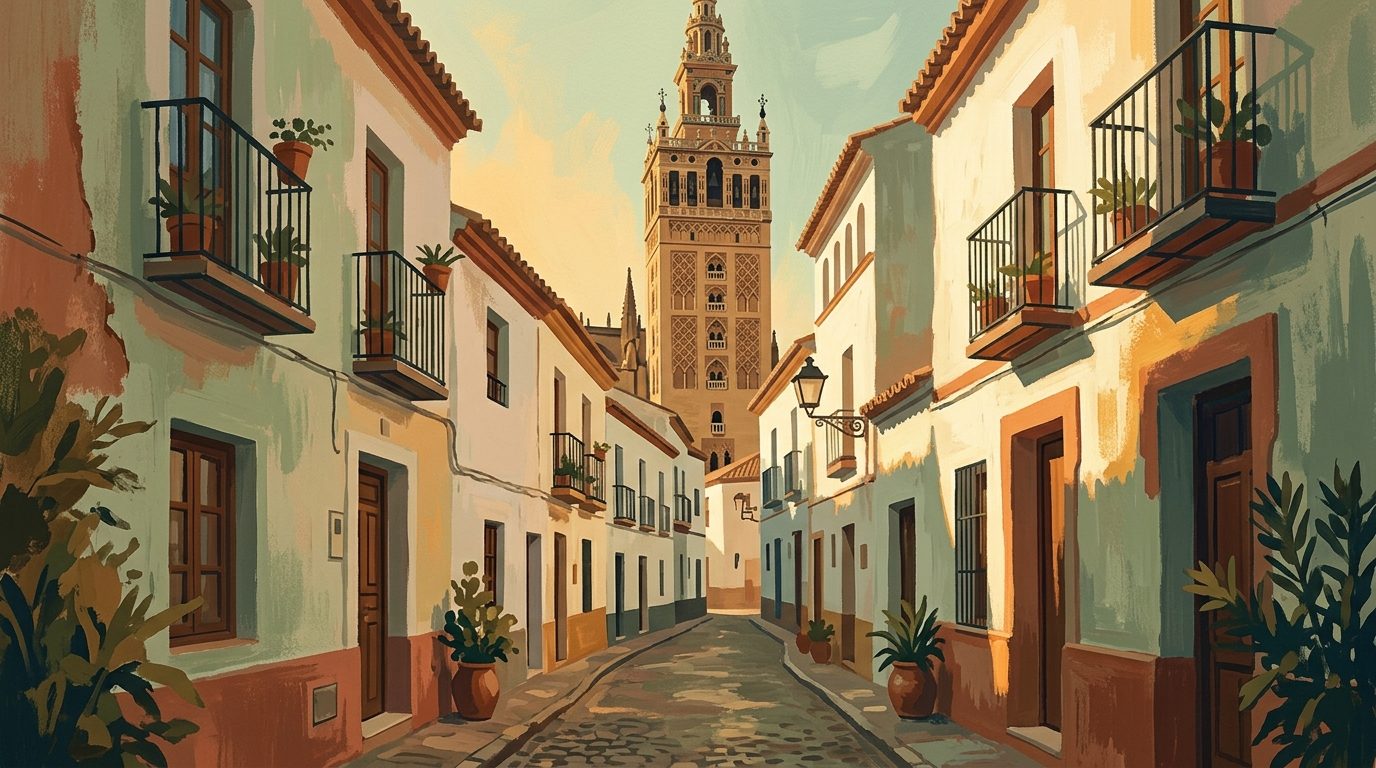
The arrival of the North African Almoravid and Almohad dynasties shifted the centre of Islamic power in the Iberian Peninsula. They brought austere religious reform, immense military strength, and a monumental architectural vision that permanently reshaped Sevilla.
In 1085, King Alfonso VI of León and Castile marched triumphantly into Toledo. The fall of the ancient Visigothic capital sent shockwaves through the fragmented Muslim kingdoms of the south. Realising that his own realm of Sevilla would be next, King Al-Mu'tamid faced a bitter choice. He could submit to the Christian king and pay crippling tribute, or he could summon help from across the Strait of Gibraltar. Al-Mu'tamid famously declared that he would rather drive camels in Morocco than herd swine in Castile. He dispatched emissaries to Yusuf ibn Tashfin, the formidable leader of the Almoravids, a fierce nomadic people from the Sahara. This fateful decision fundamentally altered the broader history of Al-Andalus (711 to 1492). Instead of remaining a collection of independent, culturally sophisticated but militarily weak city states, the Islamic territories of the Iberian Peninsula became a provincial outpost of consecutive North African empires. First came the Almoravids, followed a century later by the Almohads. Both dynasties imposed rigid religious orthodoxy upon the peninsula. They banned the consumption of wine, censored poetry, and persecuted religious minorities. Yet, they also provided an impenetrable military shield that halted the Christian advance for over a century. Crucially for the modern visitor, these ruling houses transferred enormous wealth into public works. They transformed Sevilla from a regional capital into an imperial metropolis, leaving behind monumental brick architecture that still defines the skyline of modern Andalucía.
The Almoravid Intervention
The Almoravids were a confederation of Sanhaja Berber tribes originating from the Western Sahara. Driven by a fundamentalist interpretation of Sunni Islam, they had swept out of the desert to conquer Morocco, founding the city of Marrakech in 1070. When the desperate appeal from Sevilla reached Yusuf ibn Tashfin, he crossed into the Iberian Peninsula with a massive army. In 1086, he met the forces of Alfonso VI at the Battle of Sagrajas (known in Arabic as Zallaqa) near Badajoz. The Christian army was utterly crushed, and the immediate threat to the southern Islamic kingdoms was repelled.
Initially, Yusuf ibn Tashfin returned to Africa, leaving the local kings in power. However, he was deeply appalled by what he saw as their un-Islamic behaviour. The Taifa rulers drank wine, levied illegal taxes, and maintained lavish courts filled with poets and musicians. Encouraged by local religious scholars who issued fatwas condemning the Taifa kings, Yusuf returned to the peninsula in 1090. He systematically deposed the local rulers. King Al-Mu'tamid, who had invited the Almoravids in the first place, was stripped of his wealth and exiled to the Moroccan town of Aghmat, where he died in poverty.
For the next fifty years, the Almoravids ruled the region with a heavy hand. They destroyed books of philosophy and enforced strict Malikite jurisprudence. Nevertheless, the sophisticated urban culture of Andalucía proved highly seductive. Within two generations, the fierce desert warriors had largely assimilated into the luxurious lifestyle of the society they had conquered. Their initial military vigour faded, making them vulnerable to both Christian advances in the north and a new, even more austere religious movement brewing back in the High Atlas Mountains.
The Almohad Revolution
This new movement was the Almohads (from the Arabic Al-Muwahhidun, meaning the Unitarians). Founded by a charismatic religious reformer named Ibn Tumart, the Almohads believed the Almoravids had become hopelessly corrupt and had strayed from the true path of Islam. After Ibn Tumart died, his successor, Abd al-Mu'min, transformed the religious movement into a formidable military machine. In 1147, the Almohads captured Marrakech, effectively destroying the Almoravid empire in North Africa.
The Almohads quickly crossed the Strait of Gibraltar to assert control over the Iberian territories. While the Almoravids had administered their European lands primarily from Marrakech, the Almohad caliphs chose to elevate Sevilla, making it their twin capital alongside their Moroccan headquarters. Under the rule of Caliph Abu Yaqub Yusuf and his son Abu Yusuf Yaqub al-Mansur, Sevilla experienced a period of unprecedented urban expansion and intellectual complexity.
Paradoxically, while the Almohads enforced strict public morality, they also patronised some of the greatest minds of the medieval world. The court in Sevilla hosted brilliant scholars, including the famous polymath Averroes (Ibn Rushd). Averroes wrote extensively on medicine, law, and most notably, the philosophy of Aristotle. His commentaries eventually found their way into Christian Europe, deeply influencing the development of Western scholasticism, even as his own patrons periodically banished him for holding views deemed too controversial.
Engineering and Monumental Architecture
The true physical legacy of the Almohads lies in their massive public works. They favoured a monumental architectural style that relied on scale, proportion, and the innovative use of brick, rather than the intricate stucco carving seen in earlier eras. The Almohad engineers revolutionised the infrastructure of Sevilla.
To connect the city with the suburb of Triana and secure the route to the fertile Aljarafe region, they built a pontoon bridge across the Guadalquivir river in 1171, resting it on a series of linked boats. They also constructed an extensive network of fortified walls using tapial (rammed earth), a highly durable construction method that could be erected quickly. However, their crowning achievement was the construction of a new Great Mosque. Begun in 1172 on the site of modern-day Sevilla Cathedral, the mosque was designed to rival the grandest religious structures in the Islamic world. Its soaring minaret, completed in 1198 to celebrate the decisive Almohad victory over Christian forces at the Battle of Alarcos, became the ultimate symbol of their imperial power.
The Collapse at Las Navas de Tolosa
The Almohad dominance of the Iberian Peninsula reached its zenith at the end of the twelfth century. However, their aggressive military posture provoked a unified response from the Christian kingdoms of the north. In 1212, a coalition of forces from Castile, Aragón, and Navarre, supported by crusaders from across the Pyrenees, confronted the Almohad army at the Battle of Las Navas de Tolosa. The ensuing conflict was one of the most consequential battles in European history.
The Almohad forces were decimated. The Caliph Muhammad al-Nasir barely escaped with his life, fleeing back to Marrakech. The disaster at Las Navas de Tolosa broke the back of the Almohad military machine. The empire rapidly disintegrated, fracturing into small, indefensible statelets. Within thirty-six years of the battle, Sevilla itself would fall to the Christian armies of King Fernando III, bringing the era of North African imperial rule in the peninsula to a definitive close.
Where to see it today
The architectural remnants of the Almohad empire remain some of the most recognisable landmarks in modern Andalucía.
The Giralda (Sevilla)
The minaret of the Almohad Great Mosque is now known as the Giralda. Standing at approximately 104 metres tall (including its later Christian additions), it is a masterpiece of Almohad brickwork. As you look at the tower, notice the panels of sebka decoration (a geometric, interlacing lozenge pattern made of brick) that change slightly on each tier. Inside, the tower lacks stairs. Instead, the Almohads built a series of thirty-five wide, sloping ramps, allowing the muezzin to ride a horse or donkey to the top to call the faithful to prayer. The original structure was crowned with four enormous gilded copper spheres that were supposedly visible from miles away, but these were destroyed by an earthquake in 1356 and eventually replaced by the Renaissance belfry you see today.
Patio de los Naranjos (Sevilla)
Adjacent to the Giralda lies the ablutions courtyard of the original mosque. The Almohads designed this space with an intricate grid of irrigation channels to sustain the orange trees. Many of the columns supporting the arcades are Visigothic and Roman pillars that the Almohads recycled for their own monumental project. The main northern entrance to the courtyard, the Puerta del Perdón, still retains its original horseshoe arch and spectacular Almohad bronze doors, which feature highly sophisticated geometric arabesques and Arabic inscriptions praising God.
Torre del Oro (Sevilla)
Constructed in 1220 during the final decades of Almohad rule, the Torre del Oro (Tower of Gold) served as a military watchtower defending the port. It was connected by a defensive wall to the nearby Alcázar palace complex. The tower features a distinctive twelve-sided (dodecagonal) floor plan. According to popular legend, a heavy iron chain could be drawn from the base of the tower across the river to prevent enemy ships from sailing upstream. While this makes for an excellent story, there is genuine historical debate among archaeologists about whether this specific chain mechanism existed exactly as described, though the tower's defensive function is indisputable.
If you visit
To experience these monuments at their best, plan your visit to the Sevilla Cathedral and the Giralda for the early morning, as this is the most popular historical site in the city. Purchasing a combined entry ticket online (via the official Sevilla Cathedral website), which usually includes access to the Church of San Salvador, well in advance is essential to avoid lengthy queues. Spring and autumn offer the most comfortable weather for exploring the Torre del Oro and walking the surviving stretches of the Almohad city walls near the Macarena basilica, as the intense midday heat of the Andalucían summer can make outdoor exploration exhausting. Taking time to study the exterior brickwork of the Giralda before entering the complex will give you a profound appreciation for the sheer scale of the Berber empires.
Last reviewed: 21 June 2026 · Editorial policy
Related guides
The Ghost in the Garden: Searching for the Al-Andalus Within
Eight centuries of Al-Andalus did not vanish in 1492; they simply moved indoors, into the kitchens, and onto the tip of the tongue.
7 min read
The Mudéjar Legacy: Islamic Craftsmanship Under Christian Rule
The Mudéjar style is a striking visual paradox of medieval Spain. It represents the profound aesthetic triumph of a conquered people over their conquerors, creating a unique architectural fusion that defined the visual identity of post-Reconquista Andalucía.
7 min read
The Spanish Inquisition in Andalucía: Orthodoxy and Paranoia
From its very first tribunal in Sevilla to the shadow it cast over centuries of daily life, the Spanish Inquisition demanded absolute religious conformity. Its legacy remains etched in the architecture, archives and even the culinary traditions of southern Spain.
7 min read
The Reconquista in Andalucía
The centuries-long Christian conquest of southern Iberia redefined the physical and cultural landscape of the peninsula. How did the military campaigns of the northern kingdoms dismantle the Islamic territories of Al-Andalus and forge the modern region of Andalucía?
7 min read
Corduba and Roman Baetica
Discover the political and intellectual might of Corduba, the wealthy administrative capital of Roman Baetica and the birthplace of the philosopher Seneca.
7 min read
Al-Andalus: Eight Centuries of Moorish Rule in Andalucía
For nearly eight hundred years, Islamic civilisation flourished on the Iberian Peninsula. How did a distant province of the Umayyad empire become a beacon of science, art, and poetry in medieval Europe?
8 min read
More guides
UNESCO World Heritage Sites in Andalucía
A curated guide to the cultural and natural sites in Andalucía recognised by UNESCO for their universal value. These landmarks offer a profound insight into the diverse civilisations of the region.
6 min read
The Best Beaches in Andalucía
From the Atlantic dunes of Huelva to the volcanic coves of Almería, the coastline of southern Spain offers an unparalleled variety of maritime landscapes.
6 min read
Phoenicians and Tartessians in Andalucía
Around three thousand years ago, eastern Mediterranean merchants arrived on the Iberian coast seeking silver and copper. Their arrival sparked a cultural collision that transformed local chiefdoms into the legendary civilisation of Tartessos.
6 min read
Roman Andalucía: Ruins and Archaeological Sites
Discover the monumental legacy of the Roman province of Baetica, from grand amphitheatres in the Guadalquivir valley to maritime cities on the Atlantic coast.
7 min read

Geological Wonders: Caves and Karst Landscapes of Andalucía
Discover the subterranean wonders and prehistoric secrets preserved within the limestone massifs and gypsum deposits of southern Spain.
6 min read
Castles and Fortresses of Andalucía
The fortresses of Andalucía are the stone guardians of a complex past, marking the ancient frontiers between empires and offering some of the most spectacular views in the southern peninsula.
6 min read
The Iberians in Andalucía: Warlords, Sculptors and the Dawn of Iron
Who were the sophisticated, iron-working peoples who controlled southern Spain before the Roman conquest? Their fortified hill towns and striking stone sculptures reveal a formidable culture caught between ancient local traditions and Mediterranean ambition.
6 min read
UNESCO Geoparks and Natural Wonders of Andalucía
Discover the geological heritage of Southern Spain through its UNESCO-designated geoparks and natural wonders. Explore the tectonic history and diverse ecosystems of Almería, Granada, and Cádiz.
6 min read
Cathedrals and Great Churches of Andalucía
A guide to the monumental religious architecture of Southern Spain, from the vast Gothic nave of Sevilla to the Renaissance masterworks of Jaén and Granada.
6 min read
Newsletter
More stories from Andalucía
Weekly notes, seasonal picks, and the next guides worth bookmarking.