
Feature
Sherry and the Bodegas: The 19th-Century Anglo-Andalucían Wine Trade
The fortified wines of Jerez reshaped western Andalucía. British merchants and local vineyard owners forged an industrial alliance that built enormous cellars and transformed global drinking habits.
By Dan · Updated 24 June 2026 · 7 min read
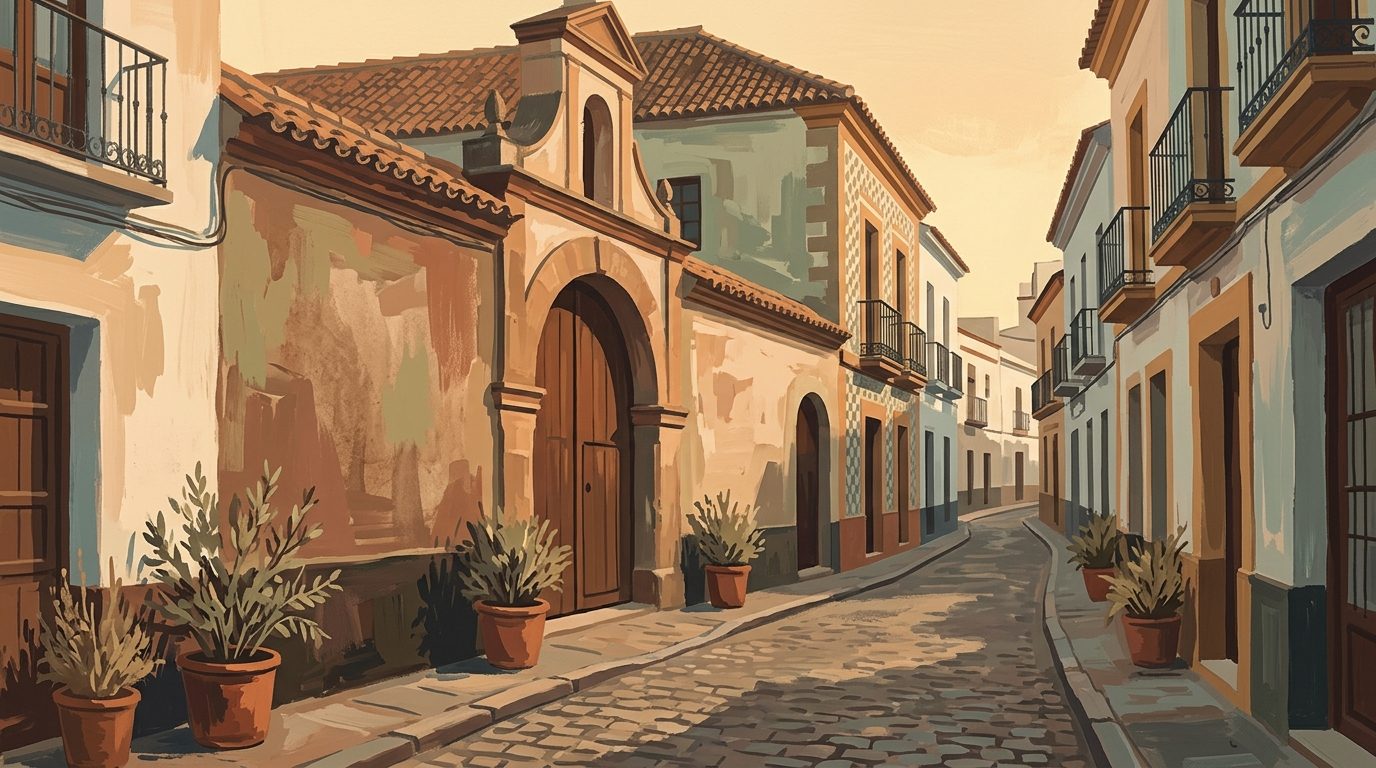
The fortified wines of Jerez reshaped the landscape of western Andalucía. British merchants and local vineyard owners forged an industrial alliance that built enormous cellars and transformed global drinking habits.
By the middle of the 19th century, the heavy scent of oxidising wine and damp earth hung permanently over the streets of Jerez de la Frontera. This was a city entirely oriented around the production, ageing, and export of fortified white wine. Set against the broader era of industrial heritage of the 19th and 20th centuries, the sherry trade created an economic ecosystem unlike any other in the region. British capital merged with local agricultural expertise to generate a booming, highly organised industry. The result was the construction of vast architectural complexes known as bodegas, which dominated the urban landscape and dictated the daily rhythms of thousands of workers.
The streets of Jerez, along with the neighbouring coastal towns of Sanlúcar de Barrameda and El Puerto de Santa María, evolved to serve the wine. Cooperages sprang up to build barrels, transport networks were overhauled, and a new class of wealthy wine barons built palaces just streets away from the industrial cellars. To understand this corner of Spain today, one must understand the unique mechanics of the 19th-century sherry trade.
The Soil and the Solera
The foundation of this empire lay in the blindingly white chalk soil of the region, known as albariza. This soil possesses a unique ability to act like a sponge. During the short, heavy rains of winter, the albariza absorbs massive amounts of water. When the fierce summer heat arrives, the surface bakes into a hard crust, trapping the moisture beneath. This geological quirk allows the Palomino Fino grapes to survive and ripen through the arid Andalucían summer without irrigation.
While English appreciation for the wines of the region dated back hundreds of years, the trade fundamentally changed in the late 1700s and early 1800s. Previously, wines were shipped as single vintages. However, merchants realised that international markets demanded consistent quality year after year. This led to the widespread adoption of a fractional blending system known as the solera. In this system, barrels are stacked in tiers called criaderas. Wine for bottling is drawn only from the bottom tier, the solera, which contains the oldest blend. That bottom barrel is then topped up with slightly younger wine from the tier above it, a process repeated up the stack.
The solera method required a revolution in business practices. A merchant could no longer simply buy a harvest, put it on a ship, and collect their profit. They now had to store thousands of barrels for years, sometimes decades, before the wine was ready. This capital-intensive model favoured wealthy British investors and local landowners, who formed powerful partnerships to finance the long wait between harvest and sale.
The Architecture of the Cathedral Bodegas
The demands of the solera system gave rise to a new and spectacular type of industrial architecture. Wine stored in barrels required stable, cool temperatures and high humidity to age properly. To achieve this in the sweltering heat of southern Spain, architects designed what became known as cathedral bodegas. These immense rectangular buildings functioned as precise climate control machines, long before the invention of modern air conditioning.
The bodegas featured soaring roofs supported by high arches or slender cast-iron pillars, allowing hot air to rise far above the resting barrels. The exterior walls were built extraordinarily thick, often using local porous stone to insulate the interior against the intense sun. Small windows were placed high up near the roofline. These windows were fitted with esparto grass blinds that could be raised or lowered to catch the cool, humid Poniente winds blowing inland from the Atlantic Ocean, while keeping out the dry, hot Levante winds from the east.
The floors of these great halls were covered in albero, the same yellow, water-retaining sand used in bullrings. Workers watered these sandy floors regularly to maintain high humidity in the air. This moisture prevented the wooden casks from drying out and cracking, and it provided the perfect environment for the flor, a layer of natural yeast that grows on the surface of some sherries, protecting the wine from oxidation and imparting a distinct flavour.
The Anglo-Andalucían Sherry Barons
The families who controlled this trade became an extraordinarily wealthy elite. Names like Osborne, Sandeman, Garvey, and Terry established themselves permanently in the region. One of the most famous partnerships began in 1835, when a young Spaniard named Manuel María González purchased a small cellar in Jerez. He soon partnered with his British agent, Robert Blake Byass, creating the firm González Byass. The company produced the internationally famous Tío Pepe brand, named affectionately after González's uncle, José Ángel, who had taught him the art of winemaking.
This Anglo-Andalucían elite transformed the social fabric of the region. They intermarried, consolidating wealth and land. They built grand, sweeping palaces in Jerez and El Puerto de Santa María. These families lived a hybrid lifestyle that merged British aristocratic pursuits with Spanish traditions. They introduced sports like polo and lawn tennis to southern Spain, whilst simultaneously breeding purebred Spanish horses, patronising traditional flamenco artists, and funding local bullfights.
Labour, Craft, and the Railway
While the merchants grew wealthy, the industry relied entirely on a massive, highly skilled labour force. Coopers shaped American oak into the 600-litre casks required for ageing. Cellar masters, known as capataces, dictated the movement of the wine based on decades of sensory experience. They walked the quiet aisles of the bodegas with their venencias, the long-handled, flexible silver cups used to plunge into a barrel and extract a sample without breaking the delicate layer of yeast on the surface.
In the vineyards, labourers worked the dazzlingly white soil under a punishing sun. The seasonal rhythm of the vendimia, or harvest, saw thousands of workers hand-picking the grapes and rushing them to the presses before they could ferment in the heat.
To move the enormous volume of wine to foreign markets, local infrastructure had to be dragged into the industrial age. In 1854, one of the earliest railway lines in Spain was constructed, linking Jerez directly to the coastal port of Trocadero. Train carriages loaded heavily with barrels rolled down to the docks, where the wine was transferred onto ships bound for London, Bristol, and the Americas. The railway solidified Jerez's dominance, allowing the bodegas to export on a truly global scale.
Where to see it today
The legacy of the 19th-century wine boom is preserved in the working cellars of the region, many of which remain in the hands of the original founding families. In Jerez, Bodegas Tío Pepe, operated by González Byass, remains a functioning monument to the trade. Visitors can walk through the Real Bodega de La Concha, a spectacular circular cellar with a cast-iron dome attributed to the engineering style of Gustave Eiffel. It was built to celebrate a visit by Queen Isabella the Second in 1862. The estate also houses extensive historical archives containing ledgers and letters from Robert Blake Byass that detail the early export trade.
In the coastal town of Sanlúcar de Barrameda, the Museo de la Manzanilla, operated by Bodegas Barbadillo, focuses on the specific biological ageing process unique to this coastal microclimate. Manzanilla sherry can only be produced here, where the sea breezes create a thicker layer of flor yeast. The museum occupies a traditional 19th-century building and displays antique cooperage tools, historical shipping ledgers, and early examples of brand advertising.
In El Puerto de Santa María, the enormous Bodegas de Mora Osborne offers a clear view into the sheer scale required by the largest export houses. The immense barrel rooms demonstrate the architectural principles of the cathedral bodega perfectly, with their damp albero floors and high, slatted windows catching the Atlantic winds.
If you visit
The Sherry Triangle, formed by Jerez, Sanlúcar de Barrameda, and El Puerto de Santa María, is most comfortably explored in spring or autumn. The summer heat in this part of western Andalucía can be intense, particularly in inland Jerez. Most historic cellars are active workplaces and require visitors to book guided tours in advance, typically via their official websites. These tours typically conclude with a tasting session that explains the different classifications of wine, from dry Fino to rich Oloroso. To understand the full historical context, plan to visit at least one large export house in Jerez and one smaller coastal producer in Sanlúcar, which will allow you to see the distinct architectural differences dictated by their specific geographical locations.
Last reviewed: 21 June 2026 · Editorial policy
Related guides
The Resurrection of the Chalk: How Sherry Escaped the Dusty Sideboard
For decades, the wines of Marco de Jerez were relegated to the back of the liquor cabinet; today, a new generation of winemakers is digging into the white earth to prove Sherry is the world's most misunderstood terroir wine.
7 min read
The Ghost in the Garden: Searching for the Al-Andalus Within
Eight centuries of Al-Andalus did not vanish in 1492; they simply moved indoors, into the kitchens, and onto the tip of the tongue.
7 min read
Baelo Claudia and the Garum Trade
On the windswept sands of the Cádiz coast, a complete Roman city was built entirely around the seasonal migration of bluefin tuna. This coastal settlement produced the empire's most prized condiment, shipping millions of amphorae to Rome.
8 min read
Uncorking Andalucía's Soul: A Journey Through the Sherry Triangle
Discover the rich traditions of Andalucía's Sherry Triangle, a captivating region where history, culture, and world-renowned sherry wine intertwine across Jerez, Sanlúcar, and El Puerto.
6 min read
The Art of the Tapeo: A Local Guide to Tapas Culture in Andalucía
Discover the unwritten rules of the Andalucían tapeo, from the legendary free tapas of Granada to the historic tabernas of Sevilla.
6 min read
A Guide to the Wines and Sherries of Andalucía
Discover the bone-dry finos of Jerez and the bold high-altitude reds of Ronda in our comprehensive guide to Andalucían wine culture.
6 min read
More guides
UNESCO World Heritage Sites in Andalucía
A curated guide to the cultural and natural sites in Andalucía recognised by UNESCO for their universal value. These landmarks offer a profound insight into the diverse civilisations of the region.
6 min read
The Best Beaches in Andalucía
From the Atlantic dunes of Huelva to the volcanic coves of Almería, the coastline of southern Spain offers an unparalleled variety of maritime landscapes.
6 min read
Phoenicians and Tartessians in Andalucía
Around three thousand years ago, eastern Mediterranean merchants arrived on the Iberian coast seeking silver and copper. Their arrival sparked a cultural collision that transformed local chiefdoms into the legendary civilisation of Tartessos.
6 min read
Roman Andalucía: Ruins and Archaeological Sites
Discover the monumental legacy of the Roman province of Baetica, from grand amphitheatres in the Guadalquivir valley to maritime cities on the Atlantic coast.
7 min read
Geological Wonders: Caves and Karst Landscapes of Andalucía
Discover the subterranean wonders and prehistoric secrets preserved within the limestone massifs and gypsum deposits of southern Spain.
6 min read
Castles and Fortresses of Andalucía
The fortresses of Andalucía are the stone guardians of a complex past, marking the ancient frontiers between empires and offering some of the most spectacular views in the southern peninsula.
6 min read
The Iberians in Andalucía: Warlords, Sculptors and the Dawn of Iron
Who were the sophisticated, iron-working peoples who controlled southern Spain before the Roman conquest? Their fortified hill towns and striking stone sculptures reveal a formidable culture caught between ancient local traditions and Mediterranean ambition.
6 min read
UNESCO Geoparks and Natural Wonders of Andalucía
Discover the geological heritage of Southern Spain through its UNESCO-designated geoparks and natural wonders. Explore the tectonic history and diverse ecosystems of Almería, Granada, and Cádiz.
6 min read
Cathedrals and Great Churches of Andalucía
A guide to the monumental religious architecture of Southern Spain, from the vast Gothic nave of Sevilla to the Renaissance masterworks of Jaén and Granada.
6 min read
Newsletter
More stories from Andalucía
Weekly notes, seasonal picks, and the next guides worth bookmarking.