
Feature · Córdoba
The Caliphate of Córdoba
In 929, Abd al-Rahman III declared himself Caliph, breaking religious ties with the Middle East and launching an era of unparalleled architectural and intellectual achievement.
By Dan · Updated 24 June 2026 · 8 min read

In 929, Abd al-Rahman III declared himself Caliph, breaking religious ties with the Middle East and launching an era of unparalleled architectural and intellectual achievement. For nearly a century, Córdoba stood as the most advanced metropolis in Western Europe.
On Friday the 16th of January 929, an ambitious Umayyad emir named Abd al-Rahman III took a step that altered the political map of the Mediterranean. He issued a decree adopting the title of Caliph, claiming absolute religious and political authority. In doing so, he elevated his domain from an emirate to a caliphate, directly challenging the Abbasid caliphs in Baghdad and the Fatimid caliphs in North Africa. Within the broader timeline of Al-Andalus (711 to 1492), this declaration sparked an unprecedented golden age. Under Abd al-Rahman III and his son, al-Hakam II, Córdoba transformed into a beacon of science, art, and diplomacy.
At its height, the Caliphate of Córdoba ruled over most of the Iberian Peninsula. Its capital was an urban marvel of paved streets, public baths, and vast libraries. Rulers from Christian kingdoms in northern Spain, as well as envoys from the Byzantine Empire and the Holy Roman Empire, travelled to the Andalucían capital to seek alliances, medical treatments, or military aid. To project this newly acquired imperial status, the caliphs commissioned monumental building projects, leaving behind architectural legacies that continue to define the physical and cultural landscape of modern Spain.
A Ruptured Dynasty and the Rise of a New Empire
The Umayyad family had once ruled the entire Islamic world from Damascus. Overthrown by the Abbasids in 750, a lone survivor named Abd al-Rahman I fled to the Iberian Peninsula, establishing the Emirate of Córdoba in 756. For the next century and a half, his descendants ruled the territory as emirs, nominally acknowledging the religious supremacy of the caliphs in the East.
By the time Abd al-Rahman III ascended to power in 912, the emirate was fracturing. Regional rebellions, particularly the long-running insurgency of Umar ibn Hafsun in the mountains of Málaga, threatened to tear the state apart. Abd al-Rahman III spent the first two decades of his reign pacifying these rebellions through ruthless military campaigns and strategic political marriages.
Having consolidated control, he sought to project unquestionable authority. Taking the title of Caliph, Commander of the Faithful, was a calculated political manoeuvre. It unified the fragmented population of the peninsula under a single religious figurehead. It also drew a firm line against the expanding Fatimid Caliphate in North Africa, which posed a direct threat to Umayyad trade routes and territorial ambitions. To back up his political claims, the new caliph reformed the military and introduced a newly minted gold dinar, tying the Andalucían economy to a standard of immense wealth generated by advanced agriculture and control of trans-Saharan trade routes.
Building the Shining City
To materialise his new imperial identity, Abd al-Rahman III required a seat of government that rivalled Baghdad and Constantinople. In 936, he ordered the construction of a palatine city at the foot of the Sierra Morena, just outside the crowded centre of Córdoba. He named it Madinat al-Zahra, the Shining City.
This sprawling complex was not merely a royal residence but an entire administrative capital. It housed government ministries, aristocratic estates, barracks, workshops, and ceremonial reception halls. Terraced into the hillside, the city was designed to awe visiting ambassadors. Emissaries would be led through ascending courtyards, flanked by uniformed guards and exotic botanical gardens, before reaching the caliph. He held court in the Salón Rico (the Rich Hall). Surrounded by intricately carved marble, horseshoe arches, and pools of water that reflected the sunlight into the shaded interiors, the caliph projected an image of divine favour and limitless power.
The construction of Madinat al-Zahra stimulated local industries. Quarries in the surrounding hills supplied the marble, while engineers repaired Roman aqueducts to supply the city with running water. Artisans refined techniques in carving, glassmaking, and ivory work. The exquisite ivory pyxides (cylindrical boxes) carved in the workshops of Madinat al-Zahra remain some of the finest examples of early medieval art in existence, often gifted to favoured courtiers and foreign diplomats.
The Intellectual Peak Under al-Hakam II
When Abd al-Rahman III died in 961, his son al-Hakam II inherited a prosperous, stable, and incredibly wealthy state. Rather than focusing solely on military expansion, al-Hakam II dedicated his reign to intellectual and cultural pursuits. He was a passionate scholar and a voracious collector of books, turning Córdoba into the intellectual capital of the Mediterranean.
Historians estimate that his royal library contained up to 400,000 volumes, an astronomical figure for the 10th century when the largest libraries in Christian Europe held only a few hundred manuscripts. Al-Hakam II employed agents across the known world to purchase rare texts in Baghdad, Cairo, and Damascus. His collection encompassed medicine, astronomy, philosophy, poetry, and mathematics. He employed a massive staff of copyists, binders, and illuminators. Among his most trusted intellectual aides was Lubna of Córdoba, a skilled mathematician and poet who oversaw the library and translated important manuscripts.
The caliph fostered a profound culture of translation and scientific inquiry. Greek texts, such as the works of Dioscorides on botany and pharmacology, were translated into Arabic, preserving and expanding upon classical knowledge. Córdoba became a magnet for scholars of all backgrounds. Muslim, Christian, and Jewish intellectuals collaborated in the caliphal court, leading to significant advancements in surgical instruments, agricultural science, and astronomical navigation. This intellectual ferment established a foundation of knowledge that would eventually filter across the Pyrenees, shaping European scientific thought for centuries.
The Expansion of the Great Mosque
Al-Hakam II's most visible legacy is his expansion of the Great Mosque of Córdoba. Recognising the growing population of the capital, he extended the main prayer hall southwards towards the Guadalquivir River. He fundamentally transformed the aesthetic and spiritual centre of the mosque by constructing a new mihrab (prayer niche) and an elaborate maqsura (the space reserved for the caliph during Friday prayers).
For this project, al-Hakam II reached out to the Byzantine Emperor in Constantinople, requesting a master mosaicist. The emperor obliged, sending a highly skilled artisan along with hundreds of cubes of gold and coloured glass. The resulting mihrab is a masterpiece of Byzantine mosaic technique adapted to Islamic aniconic tradition. It features interlocking geometric patterns, stylised floral motifs, and flowing Arabic calligraphy spelling out verses from the Quran.
The structural innovations of this expansion are equally remarkable. The ribbed domes above the maqsura, with their intersecting arches, showcase an engineering sophistication that predates Gothic ribbed vaulting by several centuries. The master builders experimented with polylobed arches, creating intricate, lace-like stone structures that supported the heavy wooden ceilings while allowing light to filter down onto the worshipping congregants.
The Collapse of the Caliphate
The brilliance of the caliphate was as fragile as it was spectacular. Following the death of al-Hakam II in 976, the title of Caliph passed to his young son, Hisham II. True power, however, fell into the hands of the ambitious vizier Almansur. Almansur was a brilliant and ruthless military commander who waged relentless campaigns against the northern Christian kingdoms, sacking cities like Barcelona and Santiago de Compostela.
While Almansur maintained the illusion of caliphal authority, he systematically isolated Hisham II in a newly built palatine city named Medina Alzahira. By concentrating all political, administrative, and military power in his own hands, Almansur thoroughly undermined the legitimacy of the Umayyad dynasty. He bypassed the traditional Arab aristocracy, relying instead on mercenary armies from North Africa to maintain his grip on power.
When Almansur died, his sons attempted to inherit his dictatorial powers, causing the political structure to buckle. In 1009, a violent rebellion erupted in Córdoba, sparking a long and devastating civil war known as the fitna. The Shining City of Madinat al-Zahra was sacked, looted, and burned to the ground. The unified state rapidly dissolved into a patchwork of competing, smaller kingdoms known as the taifas. By 1031, the Caliphate of Córdoba was formally abolished by the leading citizens of the city, ending the most unified and culturally dominant period of Andalucían history.
Where to see it today
The physical evidence of this extraordinary era is concentrated in and around modern Córdoba. The most profound site is the Mezquita-Catedral de Córdoba. Visitors can walk through the original forest of columns and clearly see the 10th-century expansion ordered by al-Hakam II, marked by more elaborate column capitals and complex arch forms. The focal point is his mihrab, where the Byzantine gold mosaics still shimmer under the low light. Looking up in the maqsura space immediately in front of the mihrab, the intricate ribbed domes demonstrate the architectural genius of the caliphal period.
Just outside the city lies the archaeological site of Medina Azahara (the modern spelling of Madinat al-Zahra), a UNESCO World Heritage site. After centuries of looting and neglect, the ruins were rediscovered in the early 20th century. Today, visitors can walk through the terraced foundations of the caliphal palace. The absolute highlight is the partially reconstructed Salón Rico, which provides a tangible sense of the intricate horseshoe arches and carved marble wall panels that once intimidated foreign ambassadors. The adjacent Dar al-Wuzara (House of the Viziers) offers further insight into the sheer administrative scale of the complex.
Back in the city centre, the Archaeological Museum of Córdoba holds critical artefacts from both Medina Azahara and the broader caliphate. Look for the exceptionally detailed bronze deer fountain spout, known as the Cervatillo, which once graced a courtyard pool in the palatine city. The museum also displays intricate marble capital stones and epigraphic inscriptions that name the caliphs and the master architects who served them.
If you visit
Start your visit at the Mezquita-Catedral early in the morning (book tickets in advance via the official website) to experience the monumental space before the largest crowds arrive. Dedicate a separate half-day to Medina Azahara, which sits about five miles west of the city centre. A dedicated shuttle bus (Bus Diario a Medina Azahara) runs from the centre of Córdoba to the Medina Azahara interpretation centre, where you then catch a smaller transfer bus up the hill to the ruins themselves. The site is highly exposed to the sun, so spring or autumn visits are far more comfortable than high summer. Keep in mind that while the Mezquita-Catedral remains open daily, most state-run museums and monuments in Spain, including the Archaeological Museum of Córdoba and Medina Azahara, are closed on Mondays.
Last reviewed: 21 June 2026 · Editorial policy
Related guides
The Granite and the Geranium: The Fragile Geometry of Córdoba’s May
For two weeks in May, Córdoba’s residents throw open the doors of their private courtyards, turning a city of stone into a living, breathing laboratory of botanical obsession.
6 min read
The Floral Courtyards of Córdoba: A Guide to the Patios and Palacio de Viana
Discover the flower-filled courtyards of Córdoba, from the twelve aristocratic patios of the Palacio de Viana to the UNESCO-listed private homes that open their doors during the May Patio Festival.
6 min read
Exploring the Caliphate Capital: A Deep Dive into Córdoba
Discover the layers of the former Caliphate capital, from the mesmerising arches of the Mezquita to the hidden floral courtyards of the Judería.
8 min read
The Ghost in the Garden: Searching for the Al-Andalus Within
Eight centuries of Al-Andalus did not vanish in 1492; they simply moved indoors, into the kitchens, and onto the tip of the tongue.
7 min read
The Morisco Revolt of the Alpujarras
The Morisco Revolt of 1568 transformed the mountainous terrain of the Alpujarras into the theatre of a brutal war. Driven to rebellion by laws erasing their culture, the descendants of Granada's Muslim population fought a desperate campaign against the Spanish Crown.
8 min read
The Frontier of Granada: Life and War on the Edge of Al-Andalus
For over two centuries, the borderland separating the Christian Crown of Castile from the Nasrid Emirate of Granada was defined by watchful towers and sudden raids. Yet this military frontier was equally a zone of profound cultural exchange, where merchants, captives and diplomats negotiated daily survival in a divided land.
7 min read
More from Córdoba
The Fall of Córdoba, 1236
In 1236, a daring winter raid by Castilian frontiersmen escalated into a full siege of the former Umayyad capital. The subsequent surrender of Córdoba marked a decisive turning point in the medieval history of the Iberian Peninsula.
8 min read
Semana Santa in Córdoba: The Definitive Guide
During Semana Santa in Córdoba, the air smells of orange blossom and incense as penitential floats pass beneath the candy-striped arches of the Mezquita.
8 min read
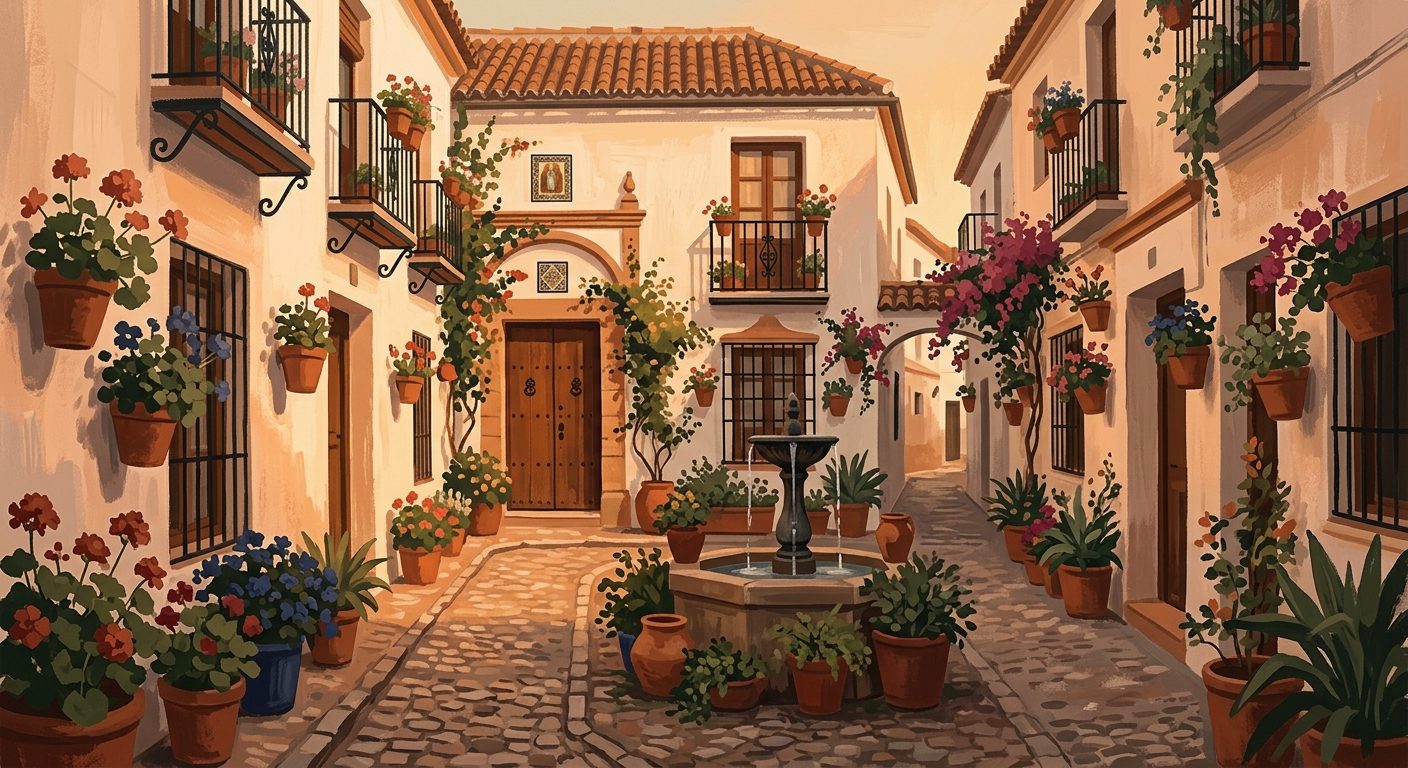
A Guide to the Patios de Córdoba
While other Andalucían festivals celebrate grand public spectacles, the Patios de Córdoba invite you into the most intimate of domestic spaces: the floral courtyards of private family homes.
10 min read
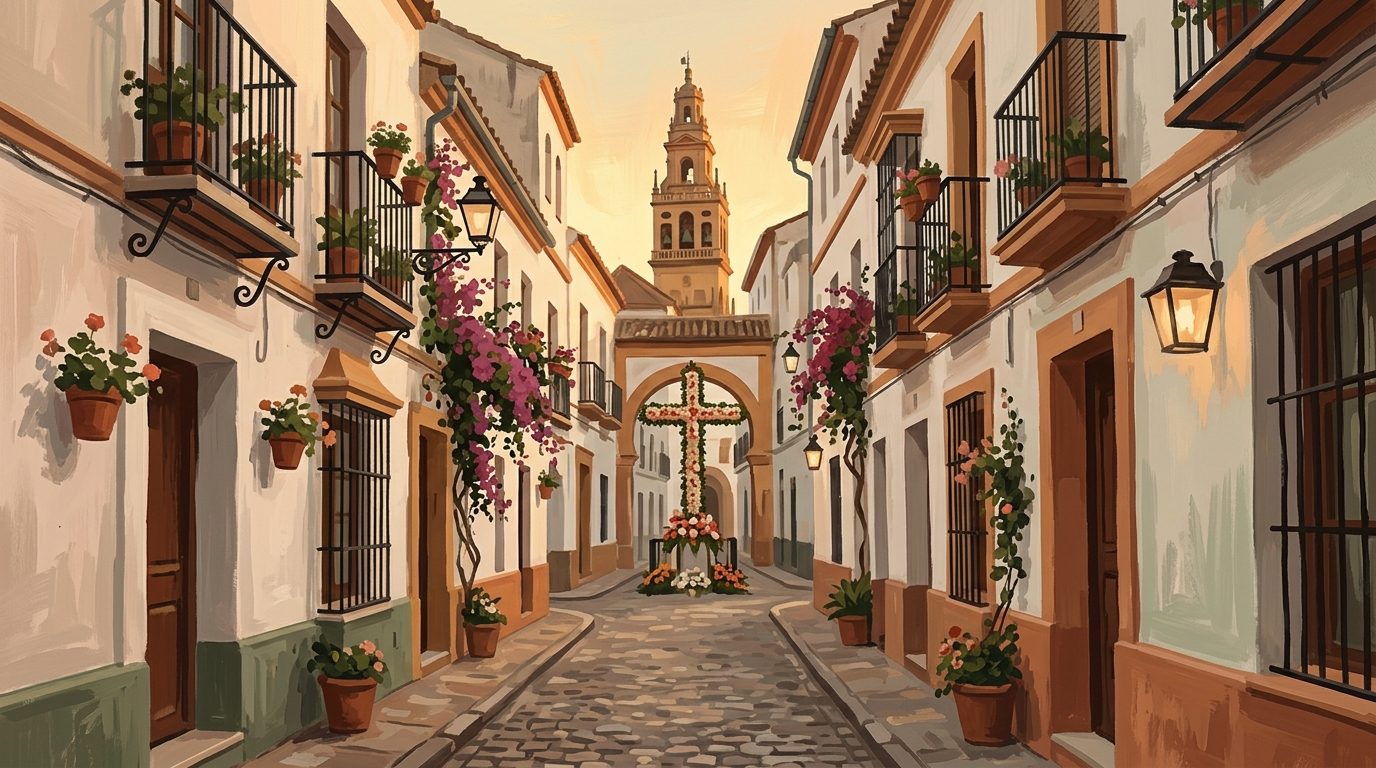
A Guide to the Cruces de Mayo Festival in Córdoba
Discover how Córdoba transforms its historic plazas into flower-draped street parties to celebrate the Cruces de Mayo festival.
8 min read
Newsletter
More stories from Andalucía
Weekly notes, seasonal picks, and the next guides worth bookmarking.