
Feature
Punic Andalucía: Carthage, Hannibal and the Struggle for the Ancient South
Discover how the trading outposts of southern Spain transformed into a heavily fortified Carthaginian empire. From the silver mines of the Sierra Morena to Hannibal's legendary oath in Cádiz, explore the sites that fuelled antiquity's greatest conflicts.
By Dan · Updated 24 June 2026 · 8 min read
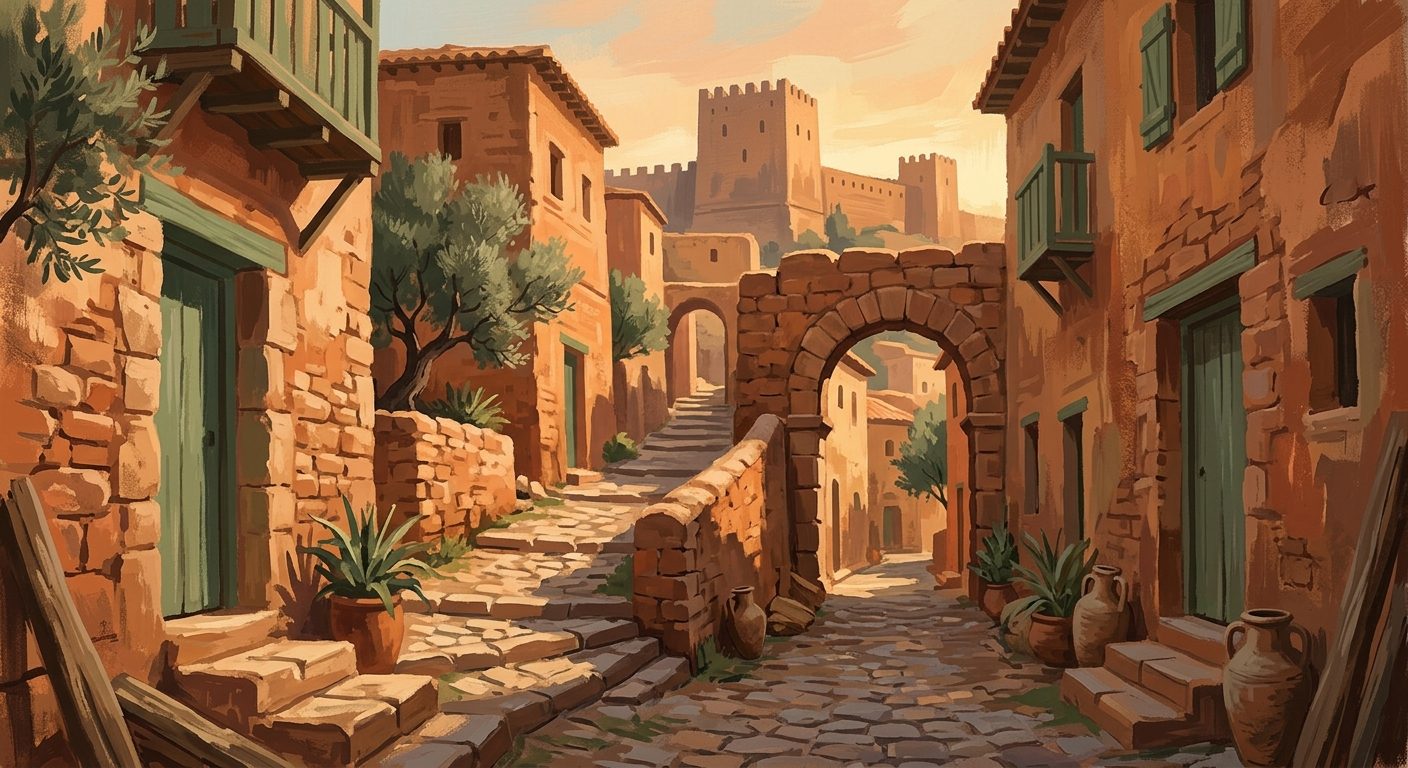
Before the legions of Rome claimed the Iberian Peninsula, the great power of the western Mediterranean was Carthage. In Andalucía, ancient Phoenician trading posts transformed into heavily fortified Carthaginian naval bases, funding an empire with local silver and launching Hannibal's legendary march over the Alps.
In 237 BC, the Carthaginian general Hamilcar Barca landed at Gadir, the ancient city that is now Cádiz. He came not merely to trade, but to forge an empire. Building upon the coastal foundations laid during the earlier era of the Phoenicians and Tartessians (between 1100 and 500 BC), Carthage sought to transform the southern coast of the Iberian Peninsula into an economic and military powerhouse. The loss of Sicily, Sardinia and Corsica to Rome in the First Punic War had devastated Carthaginian finances. To pay their massive war indemnities and rebuild their military might, the Barcid dynasty turned their eyes to the vast wealth of Andalucía. Hamilcar arrived with a clear mandate. He would secure the silver mines of the Sierra Morena, recruit the fierce local Iberian tribes into his armies, and establish a new territorial dominion that would eventually rival Rome. Gadir, already a flourishing maritime settlement, became the beachhead for a conquest that pushed deep into the Guadalquivir valley. Here, the Punic world shifted from an informal network of maritime merchants into an aggressive landholding empire.
The Rise of Carthage in Iberia
For centuries prior, the original Phoenician settlers had been content to cling to the Andalucían coastline. They built autonomous trading posts at Malaka (Málaga), Sexi (Almuñécar) and Abdera (Adra). However, when the mother city of Tyre in the eastern Mediterranean fell under the dominion of the Babylonian and later Persian empires, these independent colonies in the west were left isolated. Carthage, originally a Phoenician colony itself on the coast of North Africa, emerged as the new protective hegemon.
Initially, the Carthaginians intervened in Iberia simply to protect these coastal trading posts from the increasingly powerful indigenous tribes and from Greek commercial rivals. But protection gradually evolved into control. By the time Hamilcar Barca arrived in the third century BC, Carthage required absolute authority over the region to guarantee its own survival against the growing menace of Rome.
The Barcid Dominion in the South
Following Hamilcar's arrival, Carthaginian forces systematically brought the southern Iberian tribes under their hegemony. Through a combination of diplomatic marriages, military coercion and strategic alliances, the Barcids built a formidable state. The primary engine of this new Punic empire was mining. The hills of the Sierra Morena and the Rio Tinto basin contained some of the richest silver and copper deposits in the ancient world. Under Carthaginian supervision, immense quantities of silver were extracted. This bullion was shipped from the ports of southern Andalucía directly to Carthage, paying off Roman debts and funding a massive rearmament programme.
Historians continue to debate the exact nature of Carthaginian rule in the region. Some scholars argue that the Barcid state in Iberia was virtually independent from the Senate in Carthage, functioning as a private kingdom for Hamilcar and his successors, Hasdrubal the Fair and Hannibal. Others point to the steady flow of taxes and tribute to the North African capital as evidence of a unified imperial project. Regardless of the political structure, the impact on Andalucía was profound. Fortifications were expanded, agricultural production was intensified to feed growing armies, and local Iberian chieftains were integrated into a sophisticated Mediterranean military machine. The Guadalquivir river (known in antiquity as the Baetis) functioned as a commercial superhighway, allowing barges to transport wheat, olive oil and metal ores down to the coast for export.
Economy and Culture of Punic Andalucía
The daily experience of life in Carthaginian Andalucía was defined by a blend of Levantine and local traditions. The economy relied heavily on the sea. The Carthaginians expanded the local fishing industries, perfecting the mass production of salted fish and early versions of the fermented fish sauce that the Romans would later make famous as garum. Vast kilns were constructed along the coast to produce the ceramic amphorae necessary to transport these goods across the Mediterranean.
Religiously, the region was a melting pot. The primary deity of Gadir remained Melqart, the Phoenician patron of navigation and commerce, who was increasingly identified with the Greek hero Heracles. Yet, the Punic settlers also introduced the worship of Tanit and Baal Hammon, the chief deities of Carthage. Shrines and domestic altars from this period show a deeply syncretic culture, blending ancient Semitic religious practices with Egyptian artistic motifs and Iberian craftsmanship.
Hannibal and the Temple of Melqart
The most famous figure of Punic Andalucía is undoubtedly Hannibal Barca. According to classical sources, before embarking on his audacious campaign against Rome, a young Hannibal visited the great sanctuary of Melqart in Gadir. This temple, located on what is now the islet of Sancti Petri just south of modern Cádiz, was one of the most sacred sites in the ancient Mediterranean. It was here that Hannibal is said to have sworn his famous oath of eternal enmity against Rome, consecrating his impending war before the chief god of his ancestors.
Hannibal's army, which famously crossed the Alps to terrorise the Italian peninsula during the Second Punic War, was deeply Andalucían in its composition. The core of his infantry included Turdetani soldiers from the Guadalquivir valley, while his light infantry relied heavily on fierce Balearic slingers and Iberian swordsmen recruited from the southern highlands. The Iberian mercenaries were highly prized for their lethality. They wielded the falcata, a curved iron sword so devastating in close combat that Roman legionaries were eventually forced to redesign their shields and helmets to withstand its blows.
The Roman Retaliation and the Fall of Punic Gadir
The outbreak of the Second Punic War in 218 BC turned the Iberian Peninsula into a primary theatre of conflict between antiquity's two great superpowers. While Hannibal won spectacular victories in Italy at Lake Trasimene and Cannae, the Romans understood that they could only defeat Carthage by severing its Iberian supply lines. The Roman general Publius Cornelius Scipio, later known as Scipio Africanus, launched a brilliant and ruthless campaign to dismantle the Barcid empire in Spain.
The fighting eventually reached the south. In 206 BC, the two powers clashed at the decisive Battle of Ilipa, fought near modern Alcalá del Río in the province of Sevilla. Scipio executed a masterpiece of tactical manoeuvring. Outnumbered by the Carthaginian generals Hasdrubal Gisco and Mago Barca, Scipio held his weaker centre back while his disciplined Roman wings enveloped the Punic flanks. The resulting slaughter broke Carthaginian military power in Iberia forever. The remnants of the Punic forces retreated to their final stronghold at Gadir.
However, the citizens of Gadir, seeing that the war was lost, calculated their own survival. The city negotiated a secret surrender with Rome. When the Carthaginian commander Mago Barca attempted to return to Gadir after a naval raid, the city gates were shut against him. With its peaceful capitulation in 206 BC, the era of Carthaginian Andalucía came to a close, and the long centuries of Roman Baetica began. Yet, the Punic cultural influence did not vanish overnight. For generations, the people of the southern coast continued to worship Punic gods, speak their Semitic language, and mint coins bearing the faces of Carthaginian deities.
Where to see it today
The material remains of Punic Andalucía are scarce compared to the monumental ruins left by the Romans who followed. The Carthaginians built primarily with mudbrick and timber, and subsequent Roman urban renewal systematically erased many Punic structures. Nevertheless, several key sites and museums offer a tangible connection to this pivotal era.
Your primary destination should be the Museo de Cádiz. The museum holds the most significant collection of Phoenician and Punic artefacts in the region. The undisputed highlights are the two magnificent anthropoid sarcophagi, one male and one female, carved from marble in the eastern Mediterranean and brought to Gadir. While they date to the earlier Phoenician period, they perfectly illustrate the elite maritime culture that Carthage inherited and defended. In the surrounding display cases, you will find Punic terracottas, intricately crafted gold jewellery and the heavy ceramic amphorae used to transport salted fish across the Barcid empire. Look closely at the small terracotta figurines representing female deities, which point to the popular domestic religion of the Carthaginian settlers. Another essential piece is the Priest of Cádiz, a bronze statuette exhibiting a fascinating blend of Punic and Egyptian artistic styles.
To walk through an actual settlement of the era, visit the Castillo de Doña Blanca in El Puerto de Santa María, located just across the bay from Cádiz. While the site was founded centuries earlier, the upper archaeological layers reveal extensive Punic occupation. The settlement sits on what was once the ancient coastline, before the Guadalete river deposited centuries of silt and left the ruins stranded inland. Today, looking out from the excavated tell (an artificial mound built up from centuries of continuous human occupation), visitors can visualise the ancient bay where Carthaginian warships once dropped anchor. Here, you can trace the foundations of domestic dwellings, large industrial bread ovens, and formidable defensive walls standing over three metres high. These fortifications underscore the highly militarised nature of Punic society compared to the purely commercial Phoenician outposts that preceded it.
If you visit
The Castillo de Doña Blanca is an entirely outdoor archaeological site, making the cooler months of spring and autumn the most comfortable seasons for a visit; the site often has restricted hours during the height of summer for safety (check on the operator's website before travelling). The site is located just off the A4 motorway near El Puerto de Santa María and requires a car or taxi to reach, as public transport links are limited. The Museo de Cádiz, located in the Plaza de Mina in the historic centre of Cádiz, is currently free for EU citizens. For non-EU visitors, including those from the UK, a nominal fee of approximately €1.50 applies (check on the operator's website before travelling). The museum is closed on Mondays. Begin your exploration at the museum to understand the artefacts and the artistic culture of the Carthaginians, then drive out to Doña Blanca to walk among the architectural remains of the world that produced them.
Last reviewed: 21 June 2026 · Editorial policy
Related guides
Ink and Olive Groves: A Literary Journey through Andalucía
Discover the literary heart of Southern Spain, from the tragic poetry of Lorca in Granada to Hemingway’s dramatic Ronda and the contemplative prose of Machado in Sevilla.
10 min read
The Auto-da-Fé in Andalucía: Spectacle and Judgement
The auto-da-fé was not merely a trial, but a highly choreographed spectacle of religious and political power. Across the great squares of Sevilla, Córdoba and Granada, these public acts of faith transformed the grim mechanics of judgement into grand urban theatre.
8 min read
Expulsion of the Jews and the Conversos
The Alhambra Decree of 1492 forced a devastating ultimatum upon the Jewish population of Andalucía: exile or conversion. For those who chose baptism, the decision marked the beginning of centuries of relentless inquisitorial surveillance.
7 min read
Foundation of the Sevilla Inquisition Tribunal
In 1478, a papal bull established the Spanish Inquisition. Sevilla became the testing ground for a systematic pursuit of heresy that would define an era.
7 min read
Historical Memory and Exhumations in Andalucía: Unearthing the Past
For decades, the earth of southern Spain held the silent victims of systematic repression. Today, meticulous forensic exhumations are restoring names and dignity to thousands who lay forgotten in unmarked mass graves.
7 min read
The Long Decline and Final Abolition of the Inquisition in Andalucía
The twilight of the Holy Office was a slow, bureaucratic fading rather than a sudden collapse. Enlightenment ideals and political upheaval finally dismantled a system that had overseen centuries of religious orthodoxy.
8 min read
More guides
UNESCO World Heritage Sites in Andalucía
A curated guide to the cultural and natural sites in Andalucía recognised by UNESCO for their universal value. These landmarks offer a profound insight into the diverse civilisations of the region.
6 min read
The Best Beaches in Andalucía
From the Atlantic dunes of Huelva to the volcanic coves of Almería, the coastline of southern Spain offers an unparalleled variety of maritime landscapes.
6 min read
Phoenicians and Tartessians in Andalucía
Around three thousand years ago, eastern Mediterranean merchants arrived on the Iberian coast seeking silver and copper. Their arrival sparked a cultural collision that transformed local chiefdoms into the legendary civilisation of Tartessos.
6 min read
Roman Andalucía: Ruins and Archaeological Sites
Discover the monumental legacy of the Roman province of Baetica, from grand amphitheatres in the Guadalquivir valley to maritime cities on the Atlantic coast.
7 min read
Geological Wonders: Caves and Karst Landscapes of Andalucía
Discover the subterranean wonders and prehistoric secrets preserved within the limestone massifs and gypsum deposits of southern Spain.
6 min read
Castles and Fortresses of Andalucía
The fortresses of Andalucía are the stone guardians of a complex past, marking the ancient frontiers between empires and offering some of the most spectacular views in the southern peninsula.
6 min read
The Iberians in Andalucía: Warlords, Sculptors and the Dawn of Iron
Who were the sophisticated, iron-working peoples who controlled southern Spain before the Roman conquest? Their fortified hill towns and striking stone sculptures reveal a formidable culture caught between ancient local traditions and Mediterranean ambition.
6 min read
UNESCO Geoparks and Natural Wonders of Andalucía
Discover the geological heritage of Southern Spain through its UNESCO-designated geoparks and natural wonders. Explore the tectonic history and diverse ecosystems of Almería, Granada, and Cádiz.
6 min read
Cathedrals and Great Churches of Andalucía
A guide to the monumental religious architecture of Southern Spain, from the vast Gothic nave of Sevilla to the Renaissance masterworks of Jaén and Granada.
6 min read
Newsletter
More stories from Andalucía
Weekly notes, seasonal picks, and the next guides worth bookmarking.